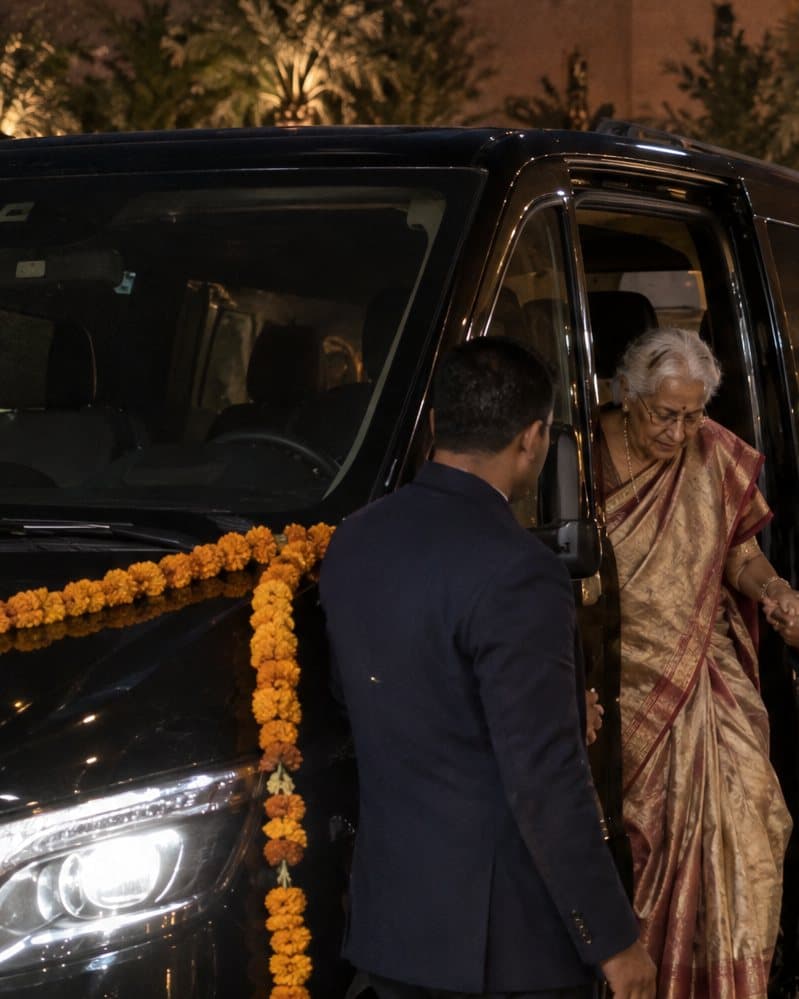
A fifty seat coach takes around twenty five minutes to load and unload in a Marrakech hotel forecourt, which is narrower than you think. For three hundred guests moving to one venue, that is six coaches and a staggered departure across forty minutes, not one departure time on an invitation.
What you actually need
Coaches for the bulk of the guest list. Minivans for the families and anyone with mobility needs. Cars for the couple and the immediate family, and one spare car that does nothing all day until the moment it saves you.
Rough maths: one fifty seat coach per fifty guests, plus twenty percent spare capacity, plus dedicated vehicles for the wedding party.
Departure times are not one time
Publish a first departure and a last departure, with coaches leaving every fifteen minutes between them. Guests who see a single time either all arrive at once, which the forecourt cannot take, or assume it is approximate.
Return journeys are worse. People leave a Sangeet in a trickle from eleven until two, so run a shuttle rather than a single return.
Briefing the drivers
Every driver gets a printed sheet: which event, which hotel, which gate, what time they return, and a named person to call. Marrakech venue entrances are often unmarked and several palaces share an approach road.
A driver who does not know which gate is the difference between guests arriving at the Baraat and guests arriving after it.
Arrivals are two days, not one afternoon
Three hundred guests do not land together. They arrive across a window of thirty six hours or more, in ones and fours, on flights that shift, and half of them will not tell you when.
So the airport needs a presence rather than a schedule: someone there through the arrival window with the flight list, a sign the family will recognise, and vehicles held nearby rather than booked to the minute. Guests who walk out of Marrakech airport into a taxi negotiation at midnight remember it, and not fondly.
Collect flight numbers with the RSVP, not later. It is one extra field and it is the difference between a plan and a scramble.
| Vehicle | Holds | What it is for |
|---|---|---|
| Coach | 45 to 55 | The main event runs, where the route allows it. Cheapest per head by a wide margin |
| Minibus | 15 to 20 | Foothill venues and narrow approaches, and the only option on some roads |
| Saloon car | 3 | The couple, the elderly, the pandit and anyone carrying the Guru Granth Sahib |
| Spare vehicle on standby | - | The one nobody budgets for and everybody uses, every single day |
The last coach home
Getting people to an event is a logistics problem. Getting them back is a human one. At one in the morning you have four hundred tired guests, some of them elderly, some of them drunk, and all of them wanting to leave at a different moment.
Run the return in waves. A first coach around eleven for the grandparents and the families with children, announced in advance so nobody feels sent home, then two more across the closing hour, then a last one that waits. The alternative is a single departure that half the party misses and the other half resents.