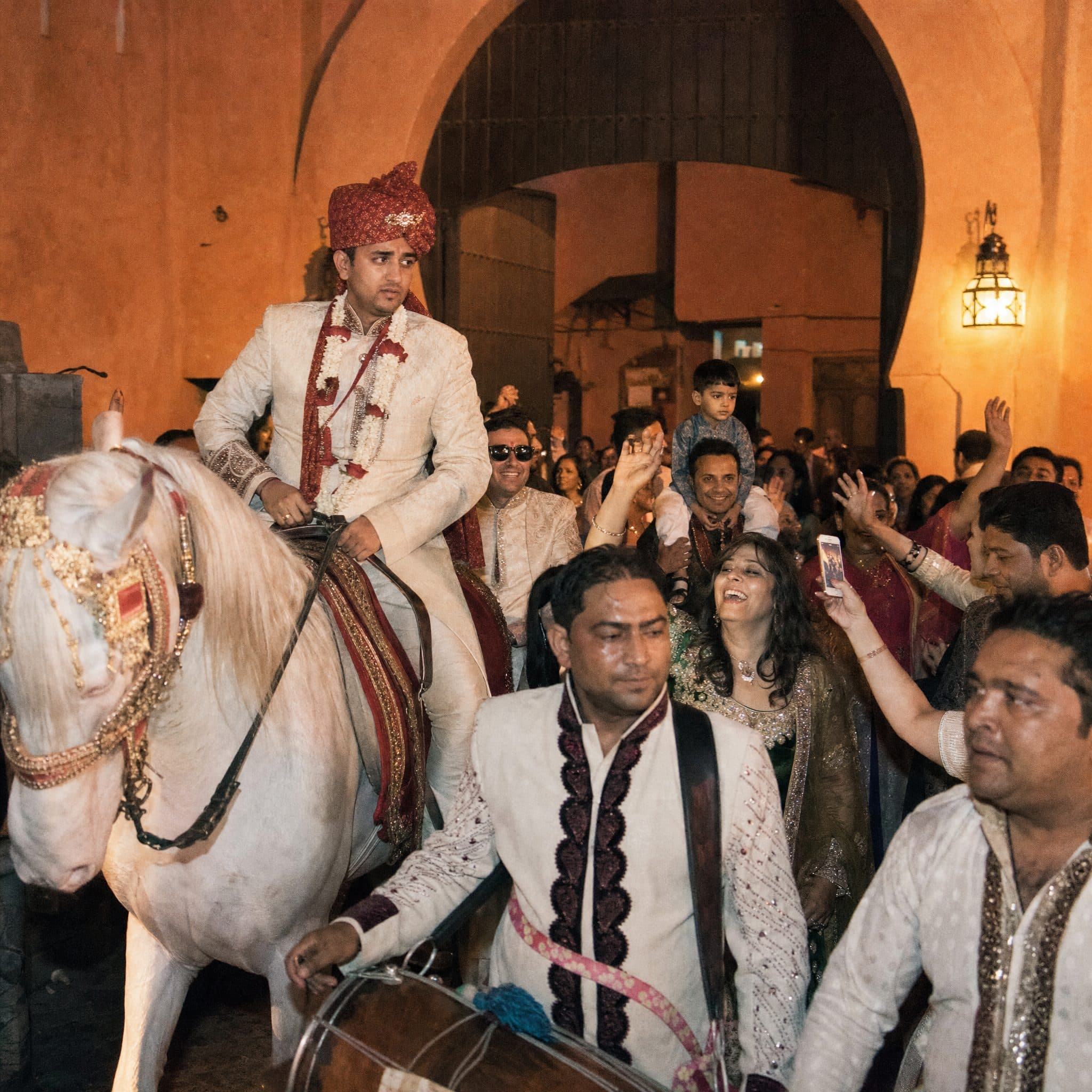
A Baraat inside the grounds of a private venue needs no permission from anyone but the venue. A Baraat on a public road in Marrakech needs a permit, and the answer depends entirely on which road.
The horse
Marrakech has good horses. The city has a working equestrian tradition and white Arabians are available, groomed and dressed, with a handler who stays for the whole procession.
What is not standard is Indian ceremonial tack. The embroidered headpiece, the mirror work, the kalgi on the groom's turban. Those either come with you in a suitcase or are made locally, and made locally takes about six weeks.
Where you can actually process
Inside a palmeraie estate or a palace's own grounds, anywhere you like. A long drive is better than a short one, because a Baraat that lasts ninety seconds is a disappointment after everyone has dressed for it.
On a public street, you need municipal permission, and it is easier outside the medina than inside it. We have never had a request refused outright, but the timing gets negotiated and a Friday afternoon near a mosque is not going to happen.
Dhol and the band
Dhol players fly in. Moroccan percussion is superb and it is not dhol, and a Baraat sounds wrong without it. Two players minimum, four if the procession is long or the guest count is above three hundred.
They need power if there is any amplification, and they need to be fed. A Baraat runs late more often than not, and dhol players who have been standing in the sun since four are not going to give you the entrance you paid for.
The hour it happens decides whether it works
A Baraat is two hundred people dancing backwards in heavy clothes, outdoors, for half an hour. In May at three in the afternoon that is not a celebration, it is an ordeal with a horse in it, and the photographs show it.
Late afternoon into dusk is the answer, and it is also when the light is worth having. Where the muhurat fixes an earlier ceremony, the Baraat still moves: it can arrive earlier and the party can wait in shade, but nobody should be dancing in direct overhead sun.
If not a horse
Plenty of grooms do not want one, and plenty of properties cannot take one. The alternatives are all real and none of them are a compromise, provided the choice is made early enough for the entrance to be designed around it.
| Arrival | What it needs | Note |
|---|---|---|
| White mare | A handler, a route with a surface she can walk, and a venue that permits her | The classic. Book early, and meet the animal before the day |
| Vintage car | A clear approach and somewhere to put it afterwards | Works beautifully at a palace gate, and it is cooler |
| Open jeep | The same, with more room for the family | Good where the approach is long or unmade |
| On foot | Nothing but the dhol | The most common, and often the best. The procession is the point, not the transport |
What the groom actually needs
One person whose only job is him. The sehra covers his face and he cannot see properly, he is on an animal he has met once, and three hundred relatives are dancing towards him.
Water before and after, somewhere to sit the moment he dismounts, and a plan for the sehra, the kalgi and the safa when they come off. They are always handed to whoever is nearest and are always missing at the Milni.