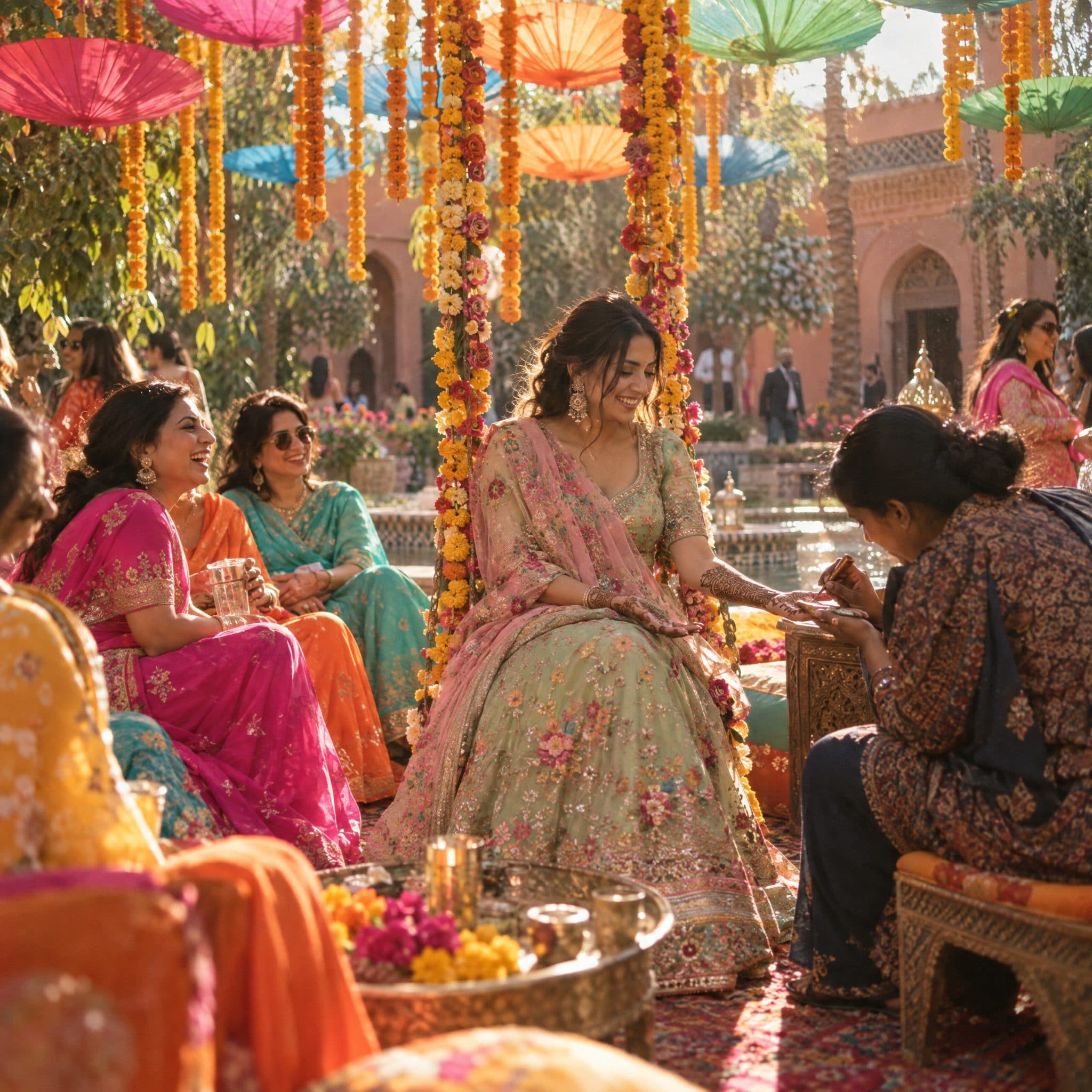
One artist does roughly six to eight pairs of guest hands an hour. For two hundred guests where maybe half want henna, that is a hundred pairs, which is four artists working five hours. Bridal mehndi is separate and takes four to six hours on its own.
How many artists, honestly
Count the women in your guest list, halve it, divide by seven, and that is artist hours. Most families under-book and then watch a queue form at the one table.
Morocco has excellent henna artists, but Moroccan henna design is its own tradition and it is not Indian mehndi. For bridal work and for guests who want Rajasthani or Arabic patterns, artists come in from India or the UK. That is flights and accommodation for four to six people, booked months out.
Start the bride early
Bridal mehndi is four to six hours for full hands and feet, longer if the design runs past the elbow. It has to be dry before she does anything else, and it has to be done before the Sangeet, not on the same afternoon.
Most brides start the bridal work the day before the Mehndi function, or first thing that morning. Nobody has ever regretted starting earlier.
What the venue needs to provide
Low seating with back support, because guests sit for an hour with their hands out. Good even light, which means shade rather than direct sun, and lamps if it runs into the evening. Somewhere for the paste to be mixed and stored cool.
And tables for the artists. Artists working on the ground for five hours is how you lose two of them to backache by the Sangeet.
What the guests actually get
Bridal henna is a different job from guest henna and it is worth saying so to the family, because the two get quoted as one number and they are not. The bride is four to six hours of close work by one artist who does nothing else that day. A guest is five to ten minutes of a simple motif, and two hundred guests at ten minutes each is thirty three artist hours.
Which is why the stations matter more than the headline artist. Three or four artists working guests in parallel from the moment the event opens, with a visible queue rather than a scrum, gets two hundred people done across an afternoon without anyone waiting an hour in the heat.
Drying time decides the rest of the evening
Henna needs two to three hours before it can be scraped, and the darkest colour comes from leaving it on longer than that. A bride whose henna goes on at four cannot dress for the Sangeet at seven without losing the depth of colour she waited all afternoon for.
So the Mehndi starts early. Bride first thing in the morning, guests through the afternoon, and the evening free. Families who schedule it the other way round spend the Sangeet photographing a bride who cannot lift her hands.
Somebody also has to feed her. Four hours seated with both hands out of use, and she will not ask.
| Hour | What is happening | Why there |
|---|---|---|
| 09:00 | Bridal henna begins, one artist, no interruptions | Four to six hours, and the colour needs the rest of the day to deepen |
| 12:00 | Guest stations open, three or four artists | Guests arrive across a long window rather than all at once |
| 13:00 | Food. Chaat and counters, nothing plated | Nobody with wet henna can hold cutlery |
| 15:00 | Bride finished and wrapped | Two to three hours before it can come off |
| 17:00 | Event closes, guests go to change | Enough gap before the Sangeet for henna to be scraped and hands washed |