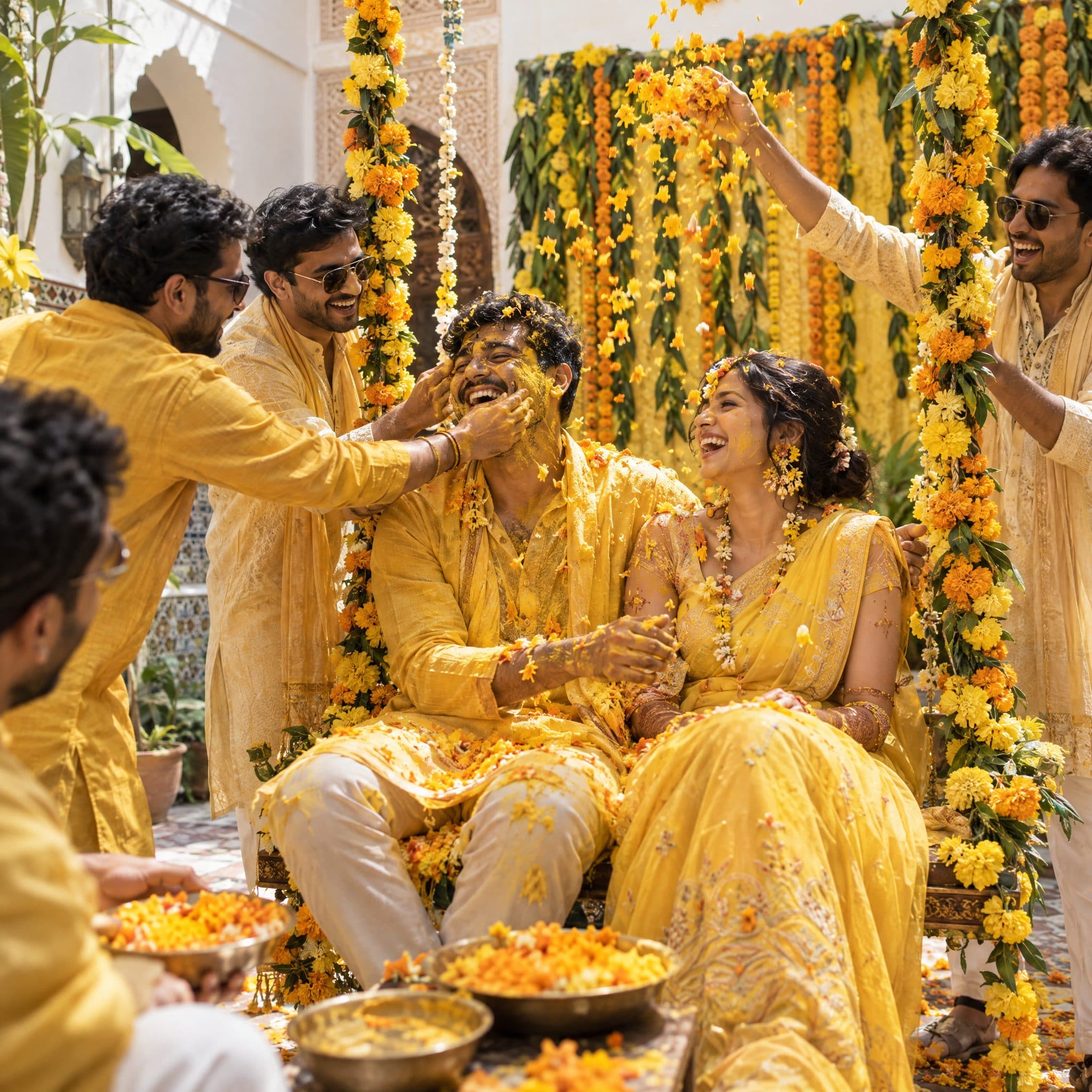
The Haldi is held in the morning in Marrakech, usually between nine and eleven. Not for tradition. For temperature. By one o'clock in May a courtyard with no shade is above 35°C and nobody wants to sit in it wearing wet turmeric.
Where it is held
A garden or a shaded courtyard, never indoors. Turmeric stains, and it stains permanently. Venues know this, and most will give you a lawn or a secondary courtyard for the Haldi rather than the main event space you are using later in the week.
Ask about the floor before you commit. Zellige tile and old marble are porous. A good venue will lay protection or point you at a garden instead. A venue that says it does not matter has not hosted one.
How many guests
Sixty to two hundred. It is the smallest event of the week and the most relaxed, which is why families who invite eight hundred to the reception keep the Haldi to immediate family and close friends.
Both sides often hold their own, at different venues, on the same morning. That is two setups, two catering runs and two photographers before lunch. It is worth saying out loud early, because it doubles the morning.
What it costs to run
The Haldi is cheap by the standards of the week. Marigold, turmeric, a small sound system, low seating and breakfast. Where it gets expensive is the floral backdrop, which is priced by the metre and photographs at the centre of every shot anyone takes.
The practical bits nobody mentions
Bring more white clothes than you think. Turmeric does not come out.
Water and shade for the older guests. A Marrakech morning in April is pleasant in the shade and punishing in the sun, and your grandparents will not ask.
Somewhere to wash. Guests go from the Haldi to lunch to getting ready for the Mehndi, and a venue with only one accessible bathroom turns that into a queue.
How the morning actually runs
It is the least formal event of the week and it still has an order. Elders first, then siblings and cousins, then whoever is brave. Turmeric on the face, the arms and the feet, applied with the fingers or a leaf, and the point of it is that everybody touches the person getting married.
The paste itself is turmeric with gram flour and often sandalwood, mixed thick enough to stay put. Somebody should be responsible for making it that morning rather than the night before, and for making twice as much as anyone thinks.
| Hour | What happens | The note |
|---|---|---|
| 08:00 | Setup, shade and floor covering | Before the heat, and before anyone is dressed |
| 09:00 | Guests arrive, breakfast | Light and hand held. People are sitting on the ground |
| 09:30 | The Haldi itself | Forty minutes to an hour. Elders first |
| 10:30 | Music, dancing, dhol | The loose part, and usually the best photographs of the week |
| 11:30 | Close, and everybody goes to wash | Well before midday, because of what the sun does to a courtyard |
Afterwards, which takes longer than anyone allows
Turmeric does not rinse off. It takes a proper wash, twice, and it will still be faintly in the hairline that evening. If the Mehndi is that afternoon, the gap between the two has to be two hours rather than one.
Hair is the real problem. Turmeric in long hair means a wash and a full dry before anything can be styled, and that is an hour of a hairdresser's time nobody scheduled. Tell the bride, tell her mother, and build it into the day.