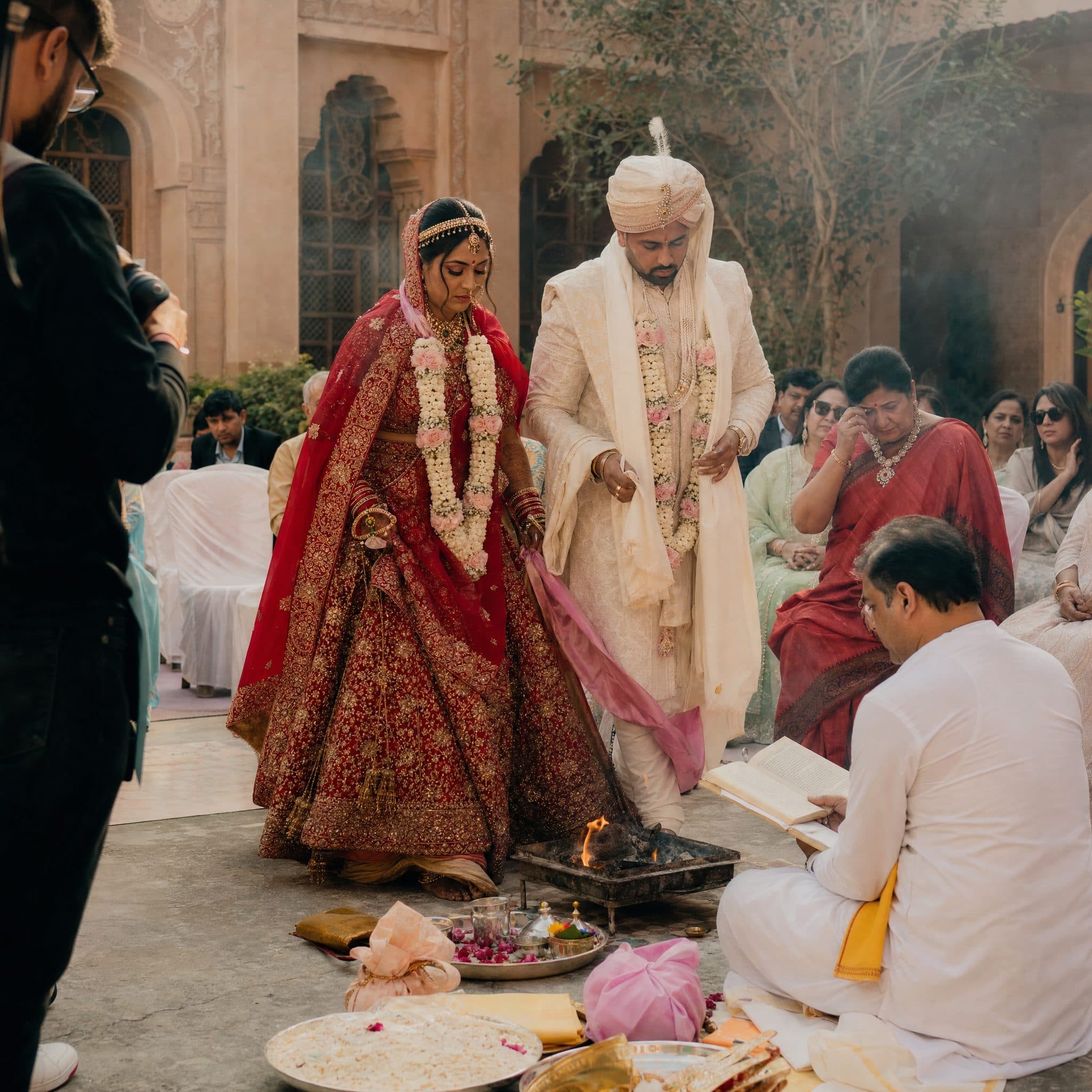
Morocco places no restriction on Hindu, Sikh or Jain ceremonies held privately. A sacred fire can be lit in an outdoor mandap with the venue's written agreement, and a Guru Granth Sahib can be installed in a room set aside for it. Neither is unusual here any more.
The mandap
Built overnight, almost always. The Sangeet strikes, the mandap goes up, and the ceremony happens the next morning or evening depending on the muhurat. That is a full night crew and it needs to be in the venue contract, not assumed.
Mandap structures are built locally from imported or locally sourced materials, or shipped in flat packed from India. Shipping takes six to eight weeks with customs and costs more than building here, but families with a specific designer often prefer it.
The fire
Outdoor, on a protected base, with the venue's written permission and usually a fire extinguisher nearby that nobody will photograph. Indoor havan is harder and most venues will say no.
Get this in writing at contract stage. A venue that verbally agreed in March and has changed its risk policy by October is a problem you cannot solve in the week of the wedding.
The muhurat
The auspicious time is set by the family's astrologer, and it is often inconvenient. Sunrise ceremonies, or a window at eleven at night. Venues here are used to European weddings that start at four in the afternoon, so the muhurat needs to be shared early and written into the schedule the venue signs.
If the muhurat lands in the middle of the night, you are paying for overnight staffing. Worth knowing before the date is fixed rather than after.
The Anand Karaj
There is no Gurdwara in Marrakech, so the Anand Karaj is held at the venue. A room is set aside and treated as the Darbar Sahib for the duration: the Guru Granth Sahib installed on the palki sahib, a granthi to do sewa and read, heads covered, shoes off, no alcohol or meat in that space.
We arrange the granthi and the installation. It takes planning rather than permission, and the venues we work with have done it before.
The four laavan are read as they would be at home. The ceremony is usually in the morning, which sits comfortably with a Marrakech schedule.
Who sits where, and for how long
The ceremony is the longest continuous sitting of the week. Pheras run an hour and a half to two hours with the immediate family on the floor around the mandap, and an Anand Karaj runs an hour or more with everybody seated on the ground facing the Guru Granth Sahib.
Which means seating is a real decision rather than an afterthought. Floor seating close in for those who want it, low chairs and benches immediately behind at the same level of participation, and proper chairs at the back for anyone who needs them, so that nobody has to ask and nobody is seated apart from their family.
Shade over all of it, not just over the mandap. A ceremony at eleven in May with the front row shaded and the rest of the family in sun is a photograph of four hundred people squinting.
| Pheras | Anand Karaj | |
|---|---|---|
| Runs for | Ninety minutes to two hours | An hour or more, plus kirtan before it |
| The focus | The mandap and the fire | The Guru Granth Sahib on the palki sahib |
| Guests | Family close in, everyone else around | Everybody seated on the ground, facing forward, heads covered |
| The space needs | Outdoors, fire permission, overnight build | A room set aside as the Darbar Sahib, no shoes, no alcohol or meat |
| Booked first | Pandit, flown with the family | Granthi, and the arrangements for installing the Guru Granth Sahib |