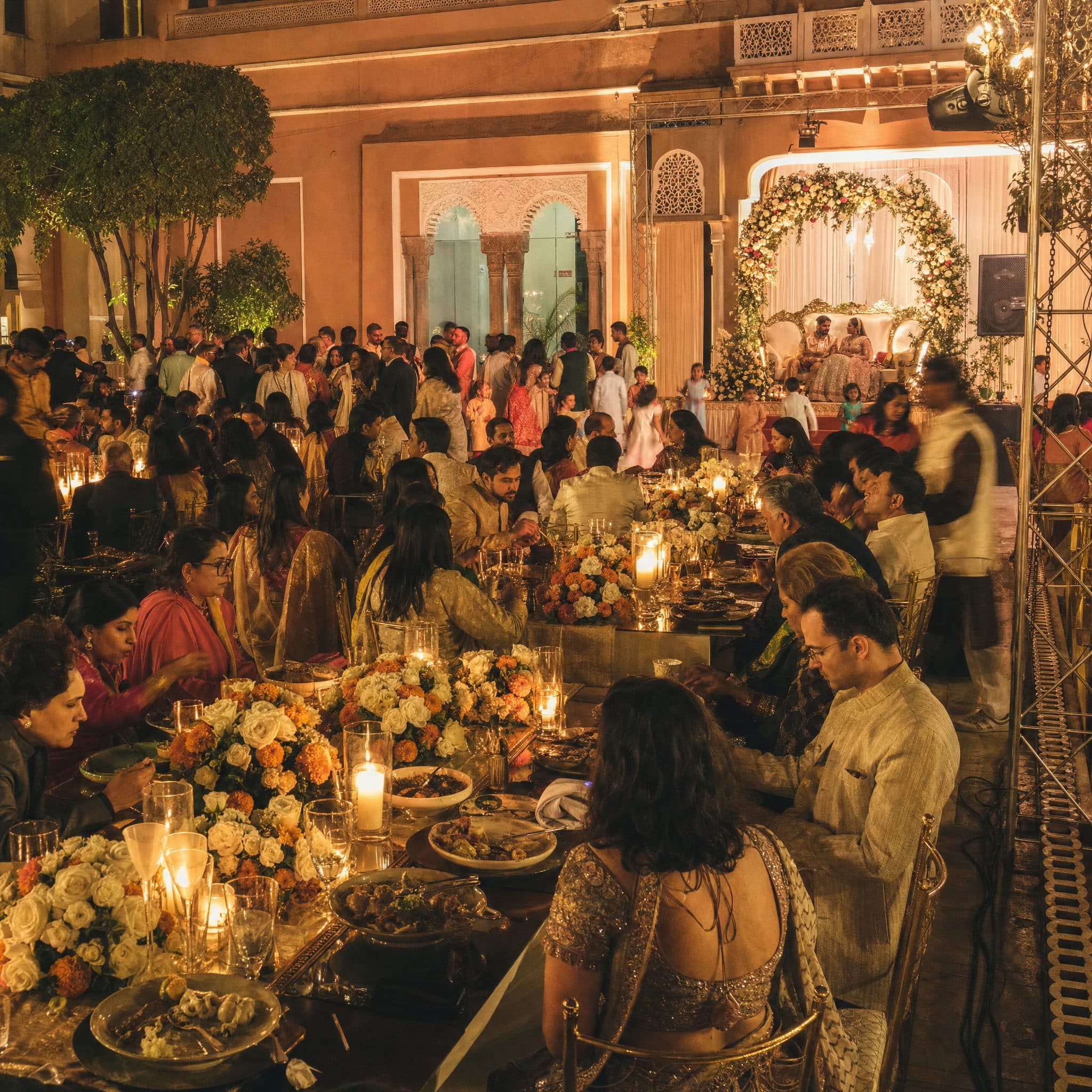
The limit on a Marrakech reception is almost never the space. It is the kitchen. A palace courtyard that seats eight hundred comfortably may have a kitchen built to serve two hundred, and the gap is filled with external kitchens, generators and a lot of planning.
Ask about the kitchen before the courtyard
How many covers has this venue actually served at once? Not how many can it seat. Ask for a date and a number.
For anything above four hundred, most Marrakech venues bring in temporary kitchen units and additional power. That is a real line in the budget and it is often missed at the quoting stage, then appears in month seven.
Service style changes the room
Plated service for eight hundred needs roughly one server for every ten guests and a kitchen that can plate at that rate. Buffet and live stations need less staff and more floor space, and they keep people moving, which most Indian receptions want anyway.
Most families here land on stations for the main and plated for dessert. It keeps the room alive and gets everyone fed inside ninety minutes.
Seating the families
Round tables of ten or twelve for eight hundred means seventy to eighty tables, which is a seating plan somebody has to actually build. Start it eight weeks out, not two.
The thing that causes the most trouble is not the plan but the changes to it. Expect fifteen percent of your confirmed guest list to move, cancel or add in the final fortnight, and design a plan that can absorb that without being redrawn.
The shape of the evening, and where it slips
A reception for several hundred people has perhaps four fixed points and everything between them moves. What slips is always the front: guests arrive late, the receiving line takes longer than planned, and by the time anybody eats the kitchen has been holding food for forty minutes.
Fix the dinner service time first and work outwards from it, rather than fixing the start and hoping. A kitchen cooking for eight hundred cannot absorb a thirty minute delay, and the difference between hot and warm is the whole meal.
| Hour | The note | |
|---|---|---|
| Guests arrive | 19:00 | Drinks and canapes somewhere other than the dining space, so the room stays unseen |
| The couple enter | 20:00 | Doors open on the room for the first time. This is the photograph |
| Dinner service opens | 20:30 | Fixed. Everything else is arranged around this, not the other way round |
| Speeches | 21:30 | After the main and before dessert. Three speeches, ten minutes total, and somebody enforces it |
| The floor opens | 22:15 | Dessert can keep running. Nobody sits back down |
| Close | 01:00 or the curfew | Whichever comes first, and it is usually the curfew |
A stage, or among the guests
A raised seat for the couple is traditional and it works at scale: eight hundred people can all see them, and the queue to greet them has somewhere to go. It also puts them above the party rather than in it for three hours.
The compromise most families land on is a stage for the first hour, for greetings and photographs, and then the couple come down and stay down. Say that in the run sheet, because otherwise nobody tells them they are allowed to.