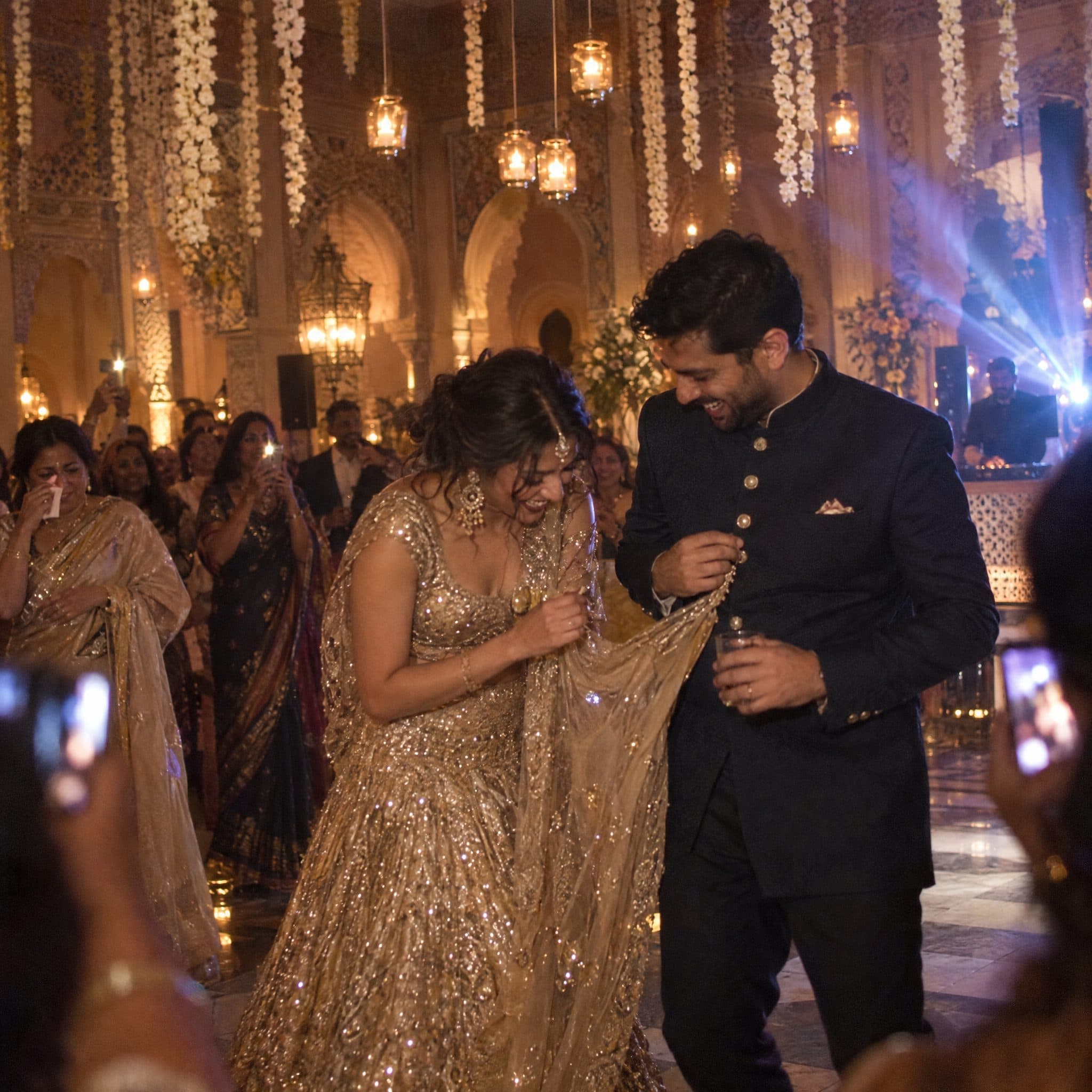
A Garba is not a Sangeet with different music. A Sangeet is performed: cousins rehearse, the family watches, and the room is set with a stage and seating. A Garba is participatory, danced in concentric circles by four hundred people at once, and it needs a large flat floor, no stage, and permission to run late. Most Gujarati families hold both, on separate nights.
The two nights, side by side
Families tell us they want a Sangeet and then describe a Garba, or book one night for both and discover in week ten that the two cannot share a floor plan.
| Garba | Sangeet | |
|---|---|---|
| Who dances | Everybody, at once, in circles | Rehearsed groups, in turn, facing an audience |
| The floor | Large, flat, continuous, non slip. This is the whole problem | Stage for performers, seating for everyone else |
| Music | Live dhol and singers, or a DJ running traditional sets | Tracks cut to choreography, cued in a running order |
| Length | Four hours and longer. It ends when it ends | Ninety minutes of performance, then a party |
| What it asks of the venue | Floor area and a late finish | Rigging, sound and rehearsal access |
The floor is the whole problem
Marrakech palaces have gravel, grass, old zellige and uneven stone. All four are beautiful and none of them are danceable in circles for four hours. A Garba needs a laid floor, level, continuous and large enough that concentric rings can turn without meeting a wall or a tree.
Work back from the number dancing rather than the number invited. Two hundred moving bodies need roughly the footprint of a tennis court, and rings form and dissolve, so the edges need clearance rather than seating pressed up against them.
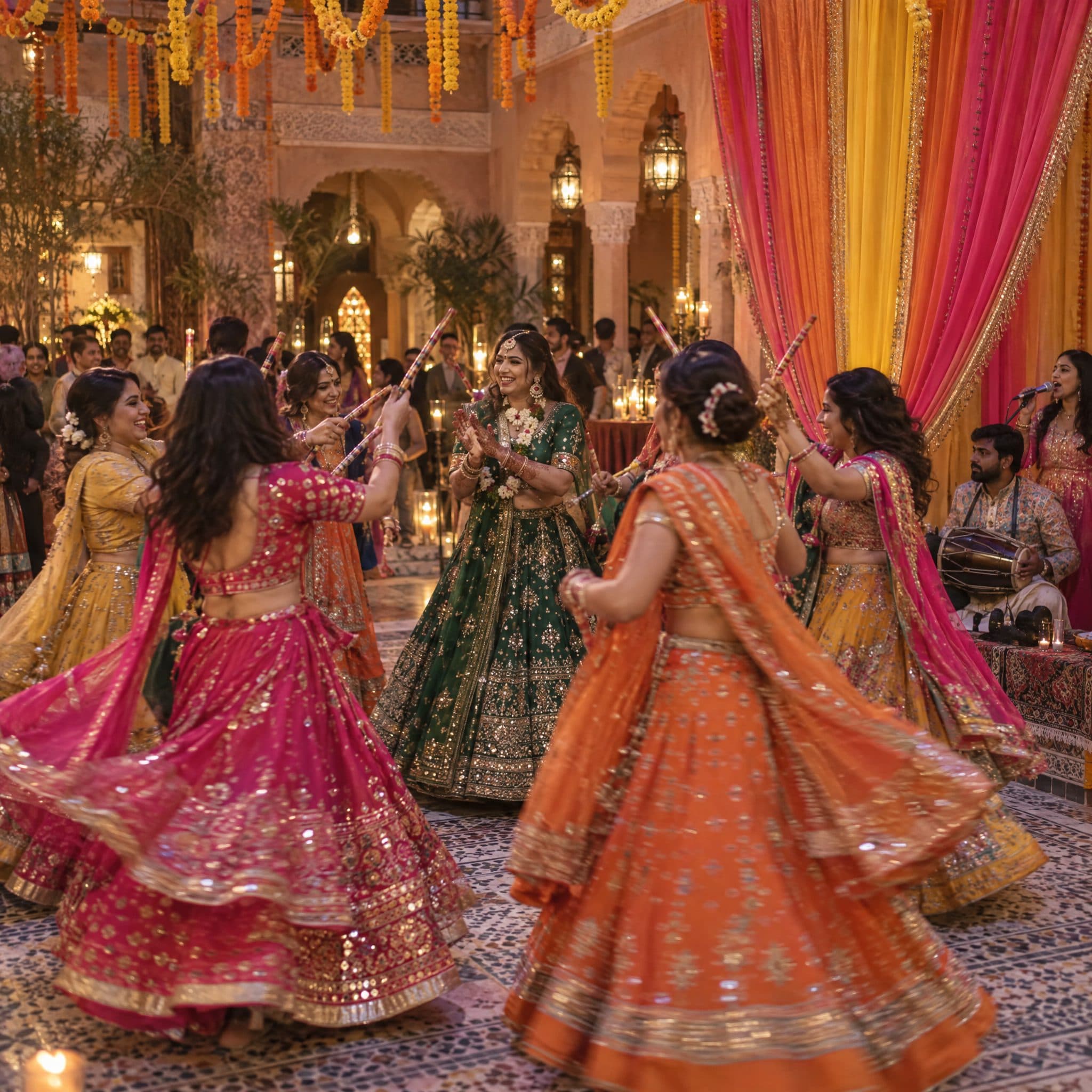
Dandiya, and the space between people
Sticks change the geometry. Dancers need more room than they do in a raas without them, and the rings run faster. Plan the floor for dandiya even if the night starts without it, because it always ends with it.
Light it low and wide rather than bright and narrow. A single bright source in the middle of a Garba blinds one half of every ring, and the light has to reach the outer edge, which is where the grandparents are watching from.
It runs late, and Marrakech has a curfew
A Garba does not have a natural stopping point the way a set of performances does, which is its whole appeal and its whole scheduling problem. Ask the venue what time music has to stop, whether that is a house rule or a municipal one, and whether a late licence is available. A house rule can sometimes be extended. A curfew cannot.
If the licence stops at one, start at eight rather than nine. An hour at the front is worth two arguments at the back.
Heat, and what everyone is wearing
Chaniya choli is heavy, layered and mirrored, and a Garba is hours of continuous movement. In April or October an outdoor Garba is comfortable from eight onwards and punishing at six.
Water at the edge of the floor rather than at a bar across the courtyard. Somewhere to sit that is not the dance floor. And a plan for shoes, because they come off.