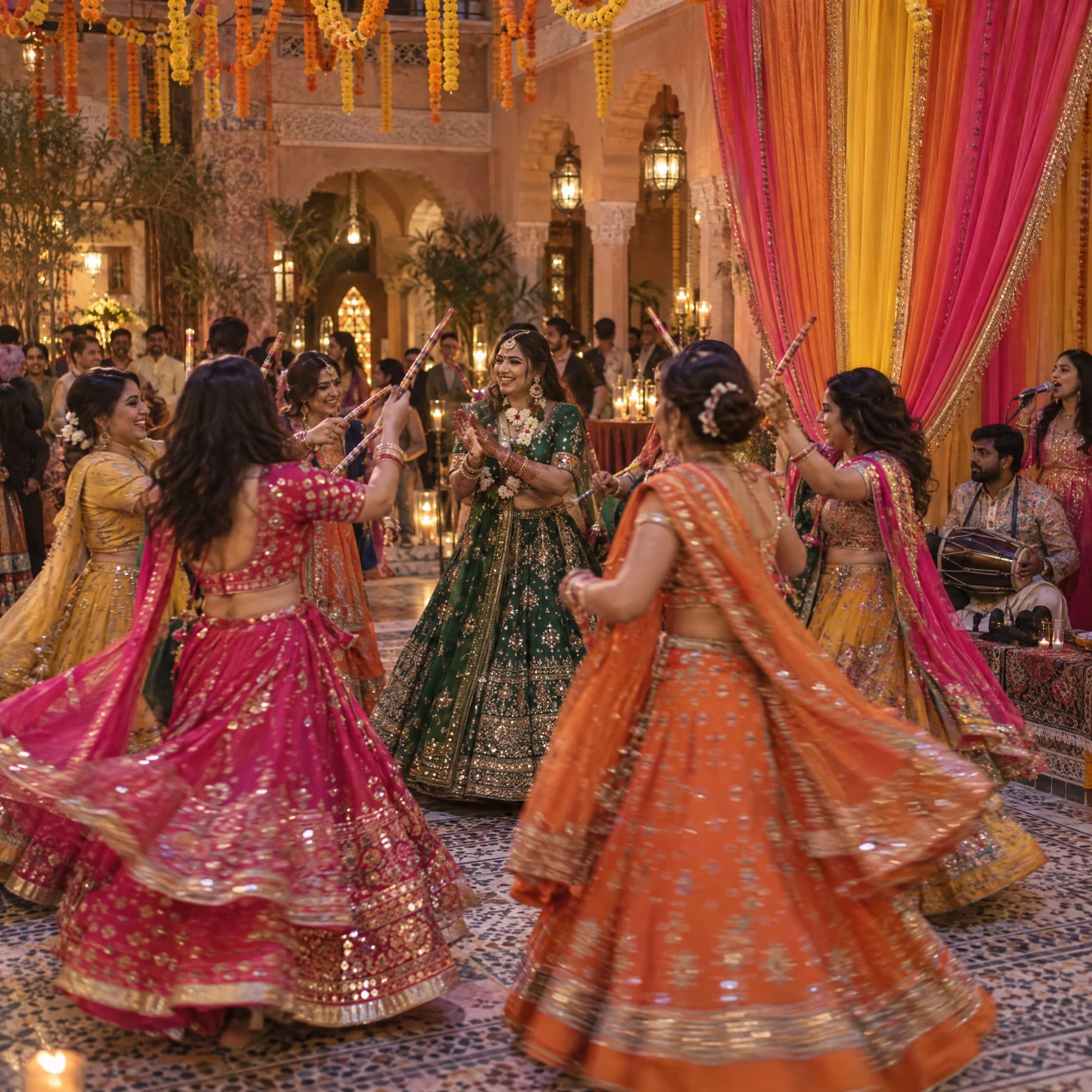
A Gujarati wedding asks three things of a venue that most destination guides skip. It needs a floor four hundred people can dance on in circles until late. It needs quiet rooms for the pujas that open the week, then a mandap with a real fire. And it needs a kitchen that cooks pure vegetarian, Swaminarayan and Jain food with no meat anywhere near it. Marrakech can give you all three. None of them come with the palace, so each one has to be planned.
Moonlight plans Indian weddings in Marrakech and nothing else: Hindu, Sikh and Jain, in private palaces, for a hundred and fifty guests or eight hundred. If you already have dates in mind, book a 30-minute introduction call and we will go through the week with you, garba night included.
What makes a Gujarati wedding week different
Three things set it apart from the Punjabi or North Indian weeks we usually describe: its own run of rites, the garba, and the food rules.
The rites have Gujarati names, and most of them come before the ceremony. Cultural India, a reference site on Indian traditions, describes them like this:
- Mandap mahurat, or mandvo mahurat: the ritual that officially starts the wedding. Each family holds it at home, and the priest prays to Ganesha to remove obstacles before the couple's union.
- Griha Shanti: a second puja, to address obstacles from unfavourable planetary positions in the couple's horoscopes.
- Mameru: the maternal uncle, the mama, brings the bride gifts the day before the wedding, such as a traditional saree, jewellery, bangles, sweets and dry fruits.
- Pithi: on the day before the wedding, a paste of turmeric, sandalwood, rosewater, herbs and mogra attar goes on the face, hands and feet of the bride and of the groom, each at home, and then they bathe.
- Jaan and varghodo: the groom visits the bride's home and touches his mother-in-law's feet for her blessing. On the day he arrives on a horse, with his relatives dancing alongside to music.
- Ponkhvu: the bride's family welcomes the groom. Her mother performs an aarti, puts a tika on his forehead and playfully tries to catch his nose before pulling him inside.
Each of these lands somewhere in a Marrakech week, and the sections below say where.
Garba comes from Gujarat. UNESCO added the "Garba of Gujarat" to its list of intangible cultural heritage in 2023. It describes a devotional dance for Navaratri, danced around a perforated earthenware pot lit with an oil lamp, or around an image of the goddess Amba, with dancers moving counter-clockwise around the centre. Gujarati folk dances are sometimes danced to mark a marriage as well.
The rites differ from one family to the next, so we build the programme from your pandit's list and your family's own order of events. If you are comparing communities, our Punjabi wedding guide covers the jaggo and the Anand Karaj, and the four days shows how a typical week is laid out.
Mandvo mahurat, Griha Shanti and the first morning
The mandvo mahurat is the puja that opens a Gujarati wedding: a priest asks Ganesha to clear the way before anything else happens. At home each family holds it in its own house. In Marrakech both families are at the same estate, so the puja moves into a room there. Your pandit fixes its form and its hour.
A room and a quiet morning
Our note on the puja that starts the week covers that room. The opening puja invokes Ganesh so the rest passes without obstacle, and Gujarati families often hold a Griha Shanti at the same point in the week. It is usually on the morning of the first day and sometimes the evening before. It happens in a room: twenty to forty people sit on the floor around the pandit.
If each side keeps its own mandvo mahurat, as it would at home, tell us early. Two pujas on the same morning mean two quiet rooms, and the venue needs to know.
The immediate family has to be in Marrakech a day earlier than everyone else. Tell them the puja date at the same time as the wedding date, so no grandmother lands straight into a ceremony.
The room also has to be asked for. On day one the build crews are already in and every quiet space has a generator behind it, so we ask anyway.
Fire indoors
Where the puja includes a small havan, it is a fire in a room. Most venues allow it in a suite with the windows open and a fire extinguisher present. Some insist on an outdoor terrace, and a few say no. Ask in the same conversation as the mandap fire.
What the pandit needs, and what travels
| Item | Where it comes from |
|---|---|
| Flowers, fruit, rice, ghee | Bought in Marrakech |
| Coconut | Bought in Marrakech, asked for in advance |
| Betel leaf and supari | Carried from home: not reliably found here, and small enough to pack |
| Idol, kalash, family items | Brought by the family |
Agree this split with your pandit about eight weeks out, so nothing gets swapped on the morning.
Bringing your pandit
The pandit flies in with the family, and the flight should be booked when the date is set. If your family follows Jain rites, the wedding is led by a vidhikarak, a lay officiant, and most families bring their own. Our note on a Jain wedding away from home covers this.
The day before: mameru and pithi
Both fall on the day before the wedding, so that day in Marrakech needs room for them.
The pithi is a turmeric paste, and what we say about the haldi in a Marrakech garden applies to it. Turmeric stains permanently. Hold it in a garden or a shaded courtyard, never indoors, and ask about the floor before you commit. Most venues will give you a lawn or a secondary courtyard. Bring more white clothes than you think, and make sure there is somewhere to wash: a venue with only one accessible bathroom means a queue.
Jaan, varghodo and ponkhvu: the groom's arrival
The varghodo meets the same Marrakech logistics we cover in the baraat note.
Marrakech has good horses. White Arabians are available, groomed and dressed, with a handler who stays for the whole procession. Indian ceremonial tack is not standard, so raise it early. Dhol players fly in: two at least, four if the procession is long or there are more than three hundred guests.
Inside a palmeraie estate or a palace's own grounds, the procession can go anywhere you like and needs permission from the venue alone. On a public street you need municipal permission. Late afternoon into dusk is the right hour, because nobody should be dancing in direct overhead sun. The ponkhvu follows when the groom reaches the bride's family.
Garba night: the floor, the hour and the heat
The garba and the sangeet are two different nights. At a sangeet, cousins perform rehearsed pieces on a stage while the family watches. At a garba, everyone dances, in concentric circles, for four hours or more. Many Gujarati families hold both, on separate nights, and each night needs its own floor plan.
The floor
Marrakech palaces have gravel, grass, old zellige and uneven stone. A garba needs a laid floor: level, continuous, and large enough that the rings can turn without meeting a wall or a tree. Two hundred dancers need roughly the footprint of a tennis court.
Plan the floor for dandiya even if the night starts without it. Dandiya raas is danced with two bamboo sticks, in two concentric circles. Sticks change the geometry: the rings run faster and dancers need more room.
The light
Light it low and wide. A single bright source in the middle blinds one half of every ring. The light should reach the outer edge, where older guests sit and watch.
The hour
A garba has no natural end the way a set of performances does, so the music curfew is the most important question you ask a venue.
Outdoor amplified music in Marrakech is generally permitted until midnight. Some private estates allow an extension, and properties in the medina or near residential streets are stricter. At one venue the limit is a house rule that can sometimes be extended. At another it is a curfew that cannot. Many families move the last hour indoors.
So start early. If the licence stops at one, start at eight. We check the specific permission in writing before a venue is confirmed, because finding out in month nine means rebuilding the plan.
The heat and the chaniya choli
Chaniya choli is heavy, layered and mirrored, and a garba is hours of continuous movement. In April or October an outdoor garba is comfortable from eight in the evening and punishing at six. Put water at the edge of the floor, close to the dancers. Give people somewhere to sit off the floor. Have a plan for shoes, because they come off.
Our full note on garba and dandiya night goes further into the floor, the light and the timing.
The mandap and the Gujarati ceremony
The mandap is built in Marrakech. Shipping a structure from India takes six to eight weeks with customs and generally costs more than building the same thing here. Fabric and draping are the exception: specific colours and weights travel well because they pack flat. Marigold, rose and foliage are bought fresh locally, and the garlands for the varmala and the mandap are made here.
The mandap's four pillars stand for the parents of the bride and groom, and the ceremony takes place before a sacred fire. Tell the decorator the fire is real. A structure over an open flame is built differently, and that decision belongs at the design stage.
The mandap goes up after the garba or sangeet comes down, overnight, in the same courtyard, and it has to be finished and dressed before the first guest arrives. That needs overnight access, working light and power. A property that locks at midnight cannot give you a mandap by morning, however willing the decorator is.
Under the mandap, the Gujarati ceremony has its own names and order. The joining of hands is called Hast-Milan in Gujarati weddings. In Gujarat a laja homa rite called the mangal phera is performed, and the couple walk four times around the sacred fire before the seven steps of the saptapadi. The ceremony is timed to the muhurat your family sets, and we plan the day backwards from that hour.
Mandap, decor, and what is built here lists what to ship and what to source.
A vegetarian kitchen in a Moroccan palace
Pure vegetarian Indian catering can be done in Marrakech. The practical limit is kitchen capacity. There is one risk to plan around: a Moroccan kitchen cooks meat by default, so the danger is cross-contamination, however careful the staff mean to be.
Three menus, three briefs
Each of these is a separate brief for the kitchen, and a single "vegetarian" headcount does not cover them.
| Menu | Excludes |
|---|---|
| Pure vegetarian | Meat, fish and egg. Dairy is eaten. |
| Swaminarayan | Meat, fish and egg, plus onion and garlic |
| Jain | Meat, fish and egg, onion and garlic, plus root vegetables: no potato, carrot or ginger |
Jain, Swaminarayan and pure vegetarian menus are cooked in separate kitchens, with their own equipment where the family requires it. Ask the venue early whether its kitchen can be fully separated, ideally with its own entrance. Give the caterer counts for each menu at each event.
Who cooks, and what travels
Indian chefs and catering teams fly into Marrakech for the week. Produce, dairy, rice and most fresh ingredients are bought here. What travels is what the chef will not compromise on: particular spice blends, specific flours and lentils, and mithai.
Scale
- Above roughly four hundred covers, temporary kitchen units and extra power are brought in.
- Plated service for eight hundred needs roughly one server for every ten guests.
- Around fifteen percent of a confirmed guest list changes in the final fortnight, so menu counts stay open until then.
Meals before sunset
Some families do not eat after sunset. That moves the service time and leaves the menu as it is. In Marrakech, sunset is close to seven in the evening in April and nearer six in November, so the main meal moves to late afternoon and the evening is left to the celebration. Venues used to European hours may not staff a late-afternoon dinner, so the timing goes into the contract.
Alcohol
Alcohol is legal in Morocco and served at licensed venues and hotels. Whether and where it is served at your wedding is a floor plan decision, and the venue's licence terms should be confirmed in writing before the contract is signed.
More on menus, staffing and live counters in feeding four hundred.
Music for the garba
Dhol players are mostly flown in. For the DJ either works: a travelling DJ knows the family's music, and a local one knows the rig and the curfew. Sound, light, staging and power are hired in Marrakech and specified event by event, the garba floor included. Singers and Bollywood artists are flown in.
How we plan a Gujarati week with you
We start from your family's own programme: which nights, which rites, which menus, how many guests at each. From there we look for a venue that can take a garba floor and give quiet rooms on day one, a lawn for the pithi, a long drive for the varghodo, a real fire under the mandap and a kitchen it can separate. We get the finish time for the music in writing before you sign.
Tell us when, roughly how many, and where everyone is flying from. That is enough to start. Book a 30-minute introduction call, or write to hello@moonlight.wedding. One of us reads every message and one of us writes back. Planners working on a Gujarati wedding can read how we work as a Marrakech ground team.
Questions families ask
What is the mandvo mahurat?
It is the puja that officially opens a Gujarati wedding. A priest prays to Ganesha to remove obstacles before the couple's union. At home each family holds it in its own house. In Marrakech it moves into a quiet room at the estate on the first morning, with the close family already there.
What happens at a pithi?
On the day before the wedding, a paste of turmeric, sandalwood, rosewater and herbs goes on the face, hands and feet of the bride and of the groom, and then they bathe. Turmeric stains permanently, so in Marrakech it belongs on a lawn or in a shaded courtyard.
Can you hold a garba at a Marrakech palace?
Yes, with a floor laid over the courtyard and the late finish agreed in writing before the contract is signed. At some venues the limit is a house rule that can be extended, at others a curfew that cannot.
What is the difference between the garba and the sangeet?
At a sangeet, rehearsed groups dance in turn while the family watches from their seats, so it needs a stage. At a garba everyone dances in circles for hours, so it needs a large level floor. Many Gujarati families hold both, on different nights.
Can Jain and Swaminarayan food be cooked at a Moroccan venue?
Yes. Each menu is cooked as its own brief, in a separate kitchen with its own equipment where the family requires it, by Indian chefs flown in for the week. The point to check with the venue is whether its kitchen can be fully separated.
When should the family arrive?
The immediate family should be in Marrakech a day before the guests, so the mandvo mahurat or Griha Shanti can be held on the first morning, before the build crews take over the venue.