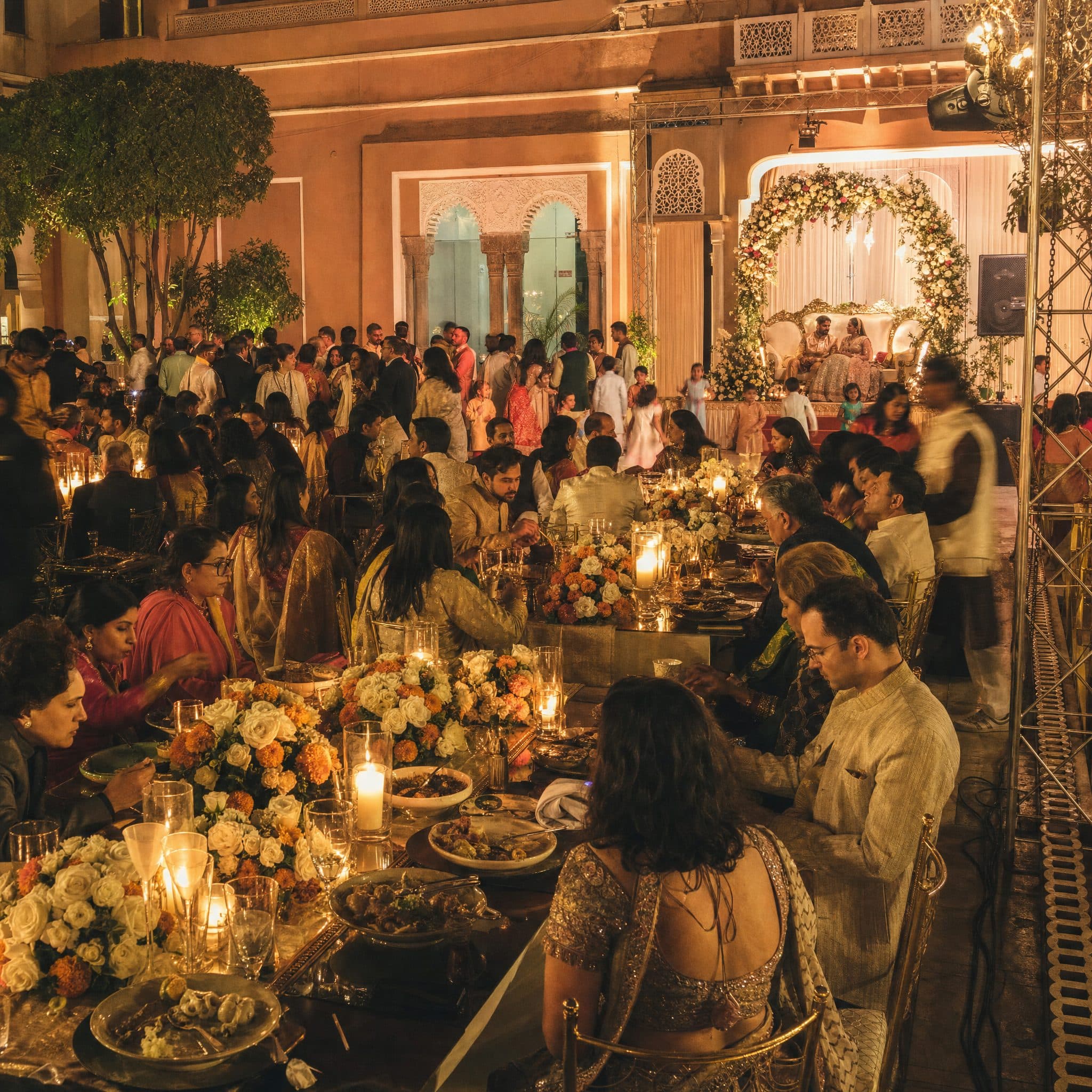
Udaipur is the benchmark for an Indian destination wedding, and it has earned that. When a family weighs it against Marrakech, we hear the same question every time: for three hundred guests over four days, which one costs less?
We don't price Udaipur, and we don't put a per-head figure on Marrakech either. What we can give you is every line that sets the cost of a 300-guest wedding in each city, what moves each one, and where the two cities differ. With that, you can read a quote from either and see what is missing.
Why we don't publish a per-head price for either city
A per-head figure for a 300-guest wedding hides the three things that set it: how many people sit down to dinner, how many days the programme runs, and how much of the week has to be flown in. We don't give one over email.
So we start from your numbers. We take your guest count, your dates and your programme, put them to venues and caterers in Marrakech, and come back with a budget made of real quotes and itemised lines you can argue with. If you already hold a Udaipur proposal, the sections below show which lines to set side by side.
If you would like to go through it on a call, book a 30-minute introduction. Bring your rough guest list and where everyone is flying from.
Where the money goes, in order
Our cost paper sets the lines out in this order, with food and production usually the two largest:
| Line | What moves it |
|---|---|
| Food and drink | Guest count first, then the number of services and the number of kitchens |
| Production and decor | How much is built, and how many times it is built |
| Venue | Season, number of days, and whether you hold it exclusively |
| Entertainment | Who is booked, and where they are flying from |
| Rooms and transfers | Headcount, number of properties, number of events a day |
| Photography and beauty | Days of coverage, and how many people are being got ready |
| Planning | Scope, and how much of it you want carried |
Venue hire sits third for a reason. A palace that seats eight hundred can cost less than the temporary kitchens, power, staging, sound and flowers that go into it. A high hire fee can still be the smaller part of the bill.
At three hundred guests, check the kitchen before the courtyard. A Marrakech courtyard that seats eight hundred may have a kitchen built to serve two hundred. Above roughly four hundred covers, most venues here bring in temporary kitchen units and extra power. A 300-guest wedding sits under that line, so the question is whether the venue's own kitchen can put out three hundred covers at once.
Service style moves the food line too. Plated service needs roughly one server for every ten guests, so about thirty for three hundred seated. Stations need fewer staff and more floor.
Vegetarian briefs count separately. Pure vegetarian, Swaminarayan and Jain are three different menus, and in Marrakech they are cooked in separate kitchens with their own pans and cooks. Give the caterer a number per event for each, early. Our catering paper explains how that is set up.
Guests times days, and events per day
The first line in any Indian wedding budget is the guest count multiplied by the number of days. That holds in Udaipur and in Marrakech alike.
Four days is the standard, and most families land on it. Day zero is arrivals and a welcome dinner, so anyone arriving the day before needs five nights of accommodation. That is most people.
Each day you add brings another night of rooms, another day of staffing, more catering, and a build and strike, and attendance on the added day is always below the RSVP. Each day you remove saves a night of accommodation for every guest, which across three hundred people adds up fast. Three days is doable, but it means combining events, and a Sangeet the night before the ceremony means a tired mandap morning.
Squeezing events together has a cost of its own. Two events in one day is two setups, two catering runs and two crews. A four-day programme with six events can cost more than a five-day programme with five. Our paper on how many days, and how many events goes through the options.
Plan for movement late on. Around fifteen percent of a confirmed guest list moves in the final fortnight, and that changes covers, rooms and coaches in either city.
The lines that exist because it is Udaipur
In Udaipur, Indian catering, mandap builders, mehndi artists, dhol players and pandits are all local. Staff at a Udaipur palace have seen a Haldi. That removes a whole category of cost and risk: nobody has to fly in a kitchen team or a dhol troupe.
What Udaipur asks of a UK or Gulf guest list is time. There is no direct flight from London. Guests connect through Delhi or Mumbai and then take a domestic leg, typically twelve to fifteen hours door to door.
British guests also need a visa for India. The Indian government's e-Visa is open to holders of United Kingdom passports, and French, Belgian and Swiss passports are on the same list. Apply at least four days before arrival. The fee is set country by country, it is non-refundable once submitted, and a 3% bank charge is added on top (Indian e-Visa portal).
Udaipur is at its best from November to February.
The lines that exist because it is Marrakech
In Marrakech the extra lines sit with the host. Indian chefs and catering teams are flown in for the week, so their flights and rooms come on top of the menu. Dhol players for the Baraat fly in too: local percussion is excellent, and it is a different instrument. The priest is the family's own pandit or granthi. There is no local substitute in Morocco, so his flight is one more line on the Marrakech side, and it goes on the plan when the date is booked.
The other half of the list stays local, and that matters when you compare with a Udaipur quote. Decor shipped from India takes six to eight weeks with customs and generally costs more than building the same thing here, so most of it is built in Marrakech. The mandap structure is built locally and can be adjusted on site. Flowers are bought here, fresh, every day. Sound, light, staging and power are hired locally, because freighting a rig costs more than renting one, and Marrakech has them in quantity. What families usually ship is fabric and draping in specific colours and weights, which pack flat. More in mandap, decor, and what is built here.
Rooms come next. Three hundred guests do not fit in one Marrakech property, and a single property rarely holds more than about a hundred and fifty. A 300-guest wedding usually needs a room block across three or four hotels within a short drive of each other and of the venue. Blocks hold an agreed rate until a release date, usually four to eight weeks out. The details are in where three hundred people sleep.
Then there is moving people. For three hundred guests going to one venue, that is six coaches and a staggered departure across forty minutes. Coaches are the cheapest option per head by a wide margin. The rough rule is one fifty-seat coach per fifty guests, plus twenty percent spare. See moving three hundred people between events.
For guests from the UK and Europe, the journey is short. Marrakech Menara is about three hours forty direct from London and seven and a half from Dubai. British, American and most EU passport holders enter Morocco visa free for short stays.
Guests from India have further to go. There is no direct service from Mumbai or Delhi, so they connect, most often through the Gulf or Casablanca, and the whole journey runs roughly eleven to sixteen hours. Indian passport holders need a visa for Morocco and there is no visa on arrival. Most use the electronic visa, which usually comes back within one to three working days. UAE residents with Indian passports still need it, because the visa follows the passport. Our visa paper covers the invitation letter.
Side by side: the 300-guest lines
| Line | Udaipur | Marrakech |
|---|---|---|
| Indian catering | Local teams | Indian chefs and teams flown in for the week |
| Mehndi, dhol, pandit | Local | Brought in; the family's own pandit flies with the family |
| Mandap and decor | Local builders | Mostly built here; shipping from India takes six to eight weeks with customs |
| Sound, light, staging, power | Ask each supplier | Hired locally |
| Rooms for 300 | Ask each venue | Usually a block across three or four hotels |
| Best season | November to February | March to May, September to November |
| From London | Via Delhi or Mumbai, typically 12 to 15 hours door to door | About 3h40 direct |
| From Mumbai or Delhi | Domestic travel | One stop, roughly 11 to 16 hours |
| British passports | Indian visa needed | Visa free for short stays |
| Indian passports | No visa | Moroccan visa needed, usually the e-visa |
Do the arithmetic on the guest list
Count where each of the three hundred guests is actually flying from. That one count decides which city costs your family more, in money and in days.
Take a list we see: two hundred guests from London, Leicester and Birmingham, sixty from Dubai and forty from India. For Udaipur, the two hundred face a connection and a domestic leg, twelve to fifteen hours door to door from London, plus an Indian visa each. For Marrakech, they fly about three hours forty direct from London with no visa. The forty from India have the longer trip to Marrakech, and each needs a Moroccan visa.
Now flip it. If your guest list is in India, Marrakech costs your family two extra days in transit each way. Udaipur suits families whose guests are mostly in India. Marrakech suits guest lists mostly in the UK, Europe and the Gulf.
What the season does to the price, and when to book
In Marrakech, the peak months are March to May and September to November, and they cost the most. In those months the good venues are gone eighteen months out. July and August come in around thirty percent less, and are regularly above 40°C. December to February is cheaper and calm but cold after dark, so an outdoor evening means heaters in every photograph. More in when to marry in Marrakech.
Room blocks come earlier than most families expect: hold them twelve to nine months out, when the venue contract is signed. Decor and mandap plans lock between nine and six months out, which leaves time for anything shipped from India. Our eighteen month timeline sets out the rest.
Udaipur peaks in winter and Marrakech in spring and autumn, so the two rarely compete for the same dates. If your family's muhurat falls in winter, that may settle the question before the budget does.
The lines families miss, in either city
These costs rarely appear on a first quote, wherever you marry:
- Meals for suppliers and staff, four days running.
- Transfers between events, on top of the airport runs.
- The last morning: a late checkout across a block booking costs very little when it is agreed at contract stage.
- Overtime past a noise curfew.
- Duty on anything shipped.
- Temporary kitchens and extra power, the item most often missing from early quotes, which tends to surface in month seven when the catering plan is signed.
- A contingency line, held at the start and not spent in month three.
Alcohol is legal in Morocco and served at licensed venues and hotels. Confirm the venue's licence and its terms in writing before you sign.
If you are also weighing Italy, Portugal or Spain, our paper on Europe or Marrakech goes through the same questions.
Questions
What sets the cost of a 300-guest wedding in Udaipur?
We don't price Udaipur. The same lines apply there as anywhere: guests times days, food and production first, then the venue and the season, with November to February the best months. Its advantage is that Indian caterers, mandap builders, mehndi artists, dhol players and pandits are local, so nothing has to be flown in. Ask every Udaipur venue for an itemised quote that separates rooms, food, decor and taxes.
Is Marrakech cheaper than Udaipur for an Indian wedding?
It depends on where your guests live. For the host, Marrakech adds flown-in Indian chefs, dhol players and the family's pandit, which Udaipur does not need, while decor, sound, light, staging and power are sourced locally. For guests from the UK, Marrakech is about three hours forty direct from London with no visa for British passports, against a connection and twelve to fifteen hours to Udaipur.
What is the most expensive part of a 300-guest Indian wedding?
Usually food and drink, then production and decor. Both grow with the guest count. Venue hire is rarely the largest line.
Is it cheaper to ship decor from India to Marrakech?
Usually not. Decor shipped from India takes six to eight weeks with customs and generally costs more than building the same thing in Marrakech. Families mostly ship fabric and draping, plus any statement piece they want from a specific designer.
How many hotels do 300 guests need in Marrakech?
No single Marrakech property holds three hundred guests. Plan a room block across three or four hotels near each other and the venue, with a release date usually four to eight weeks before the wedding.
How far ahead should we book a Marrakech wedding venue?
For peak months, March to May and September to November, the good venues are gone eighteen months out. Hold room blocks twelve to nine months out.
Do guests need a visa for Udaipur or Marrakech?
British passport holders need a visa for India and can apply online for an e-Visa at least four days before arrival. They enter Morocco visa free for short stays. Indian passport holders need a visa for Morocco, usually the electronic one.
Tell us about the wedding
Moonlight plans Indian weddings in Marrakech and nothing else: Hindu, Sikh and Jain, for a hundred and fifty to eight hundred guests, over three to five days. We have been in Marrakech ten years and know which venues permit a fire.
Tell us when, roughly how many, and where everyone is flying from. We put your numbers to real venues and caterers and come back with itemised lines you can set against your Udaipur quote. Book a 30-minute introduction call, or read what it costs to marry here and Marrakech or Udaipur first.
If you are a planner with a client weighing both cities, we work as your ground team in Marrakech, and your client relationship stays yours.