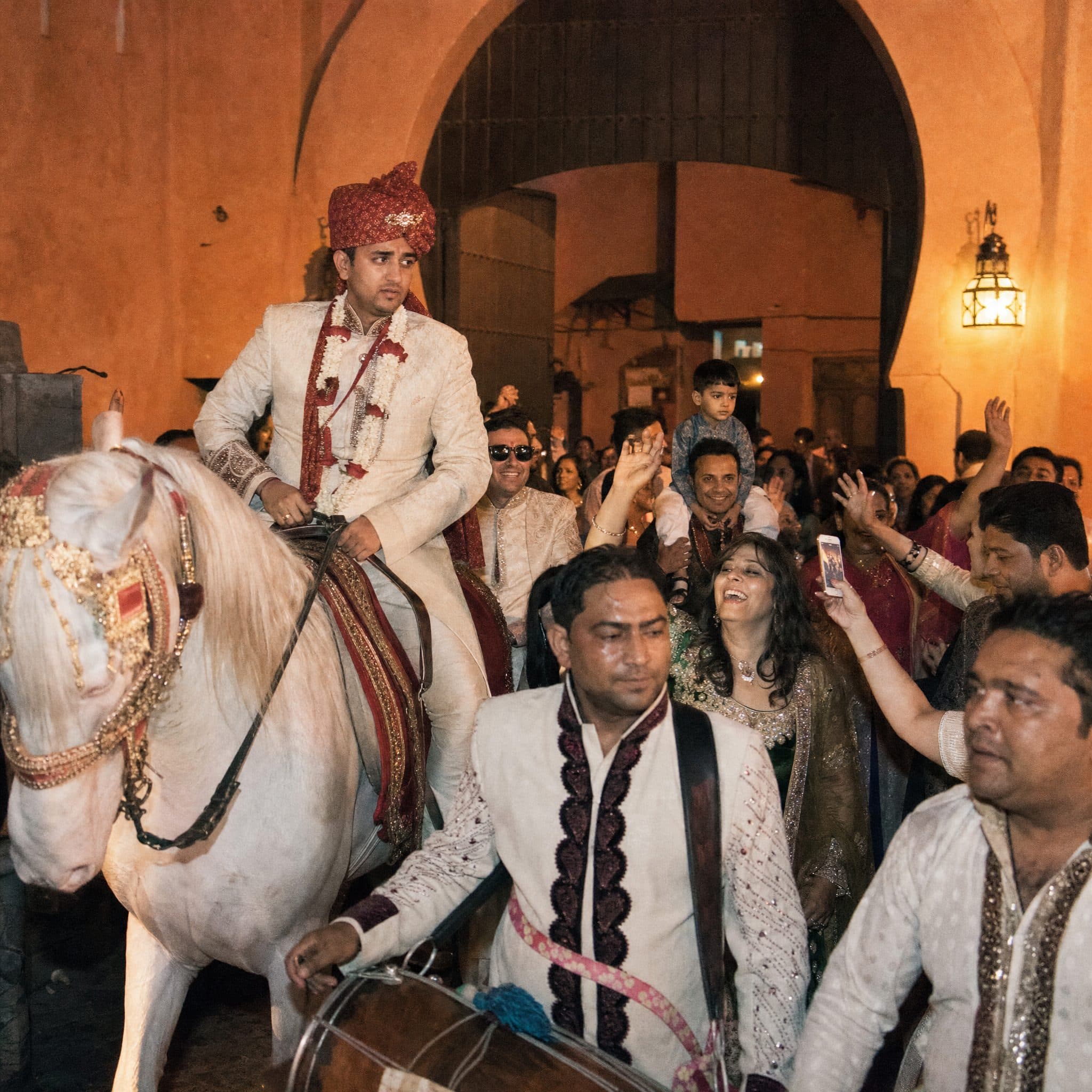
A Punjabi wedding needs loud nights, a mare at the gate, a long dance floor and a ceremony done properly. The private palaces and estates around Marrakech can hold all of it, for 150 to 800 guests. Moonlight plans Indian weddings here and nothing else: Hindu, Sikh and Jain. A Punjabi celebration leans on the Baraat and the Sangeet, and we plan it to your family's own rites.
Below, the Punjabi rites in order, what each one needs in Marrakech, and what we do about it. If you would rather talk it through with your parents on the line, book a thirty-minute introduction call and bring rough dates.
The Punjabi rites, one by one
Here is the usual sequence of rites, with what each one is (from Wikipedia's Punjabi wedding traditions) and what it needs once the family is in Marrakech.
Roka and chunni chadana
The roka marks the end of the courtship and the point where both families start planning together. At the chunni chadana, the groom's family gives the bride a chunni, a drape that stands for her acceptance into the family. Some families fold it into the roka. Both happen long before anyone books a flight.
Maiyan and the Haldi
Maiyan is an evening festival at the couple's parental homes. The vatna is a paste of turmeric powder and mustard oil applied all over the bride. In Marrakech the Haldi is held in the morning, usually between nine and eleven, in a garden or a shaded courtyard and never indoors. By one o'clock in May, a courtyard with no shade is above 35°C.
Turmeric stains for good, so bring more white clothes than you think you need. Have someone make the paste that morning rather than the night before. More in Haldi in a Marrakech garden.
Mehndi
The Mehndi is a party with singing, dancing and food, built around henna. Henna for the bride is easy to book. Henna for two hundred guests is the real job: one artist does roughly six to eight pairs of guest hands an hour, and the henna needs two to three hours before it can be scraped off. Guests sit for an hour with their hands out, so the seating is low, with back support. The numbers are in Mehndi at guest volume.
Chooda and kaleere
The chooda is a set of red bangles given to the bride by her mama, her mother's brother. Relatives then tie kaleere to them: silver, gold or gold-plated ornaments.
Joota chupai
Joota chupai means "hiding the shoes". The bride's sisters take the groom's shoes and charge him a fee to give them back. On a day when shoes come off for the ceremony, they will have their chance.
The jaggo and the Sangeet: the loud nights
The jaggo is the family's late-night celebration before the wedding. According to Wikipedia, relatives sing and dance in the decorated wedding home in the last hours of the night and carry lit vessels from house to house. At a Marrakech estate, a jaggo needs three things from the property.
The first is a sound limit you know in advance. Outdoor amplified sound is generally allowed until midnight. Some private estates further out of town can extend to one or two in the morning, and properties inside the medina or close to residential streets are stricter. The usual answer is to move the last hour indoors, where the limit does not apply.
The second is the dhol. Moroccan percussion is excellent, but it is a different instrument, so dhol players come in by plane.
The third is having the place to yourselves. On a four-day programme, exclusive use of the property gives your family somewhere to be loud at two in the morning without a stranger complaining.
Here is our part. We check the specific sound permission in writing before a venue is confirmed, and permits, noise curfews and build access are all agreed in writing. When a venue gives you a curfew, ask whether it is a local rule or a house rule. A house rule can sometimes be extended with a late licence.
The Sangeet comes before the wedding day, because it is the loudest night and the ceremony is the quietest hour. A full stage is a two-day build at most Marrakech venues, and some palaces allow no building after ten at night because guests are sleeping on site. For the cousins rehearsing, budget two hours on the stage with the real sound and lighting. Keep the show to ninety minutes, which is eight or nine performances. Our Sangeet paper covers the build and the running order.
Sehra bandi, ghodi chadna and the Baraat
At the sehra bandi, the groom's sister ties the sehra on his head, and guests give gifts and cash for luck. At the ghodi chadna, his sisters and cousins feed and dress his mare, and he rides off to the wedding venue.
Marrakech has good horses, and the handler stays for the whole procession. Indian ceremonial tack is not standard here. Having it made locally takes about six weeks, so it goes on the list early.
The sehra, the kalgi and the safa always get handed to whoever is nearest, and they always go missing before the Milni. Give the groom one person whose only job is him.
A Baraat inside the grounds of a private venue needs only the venue's agreement. On a public street it needs municipal permission, which is easier outside the medina than inside it. From April the middle of the afternoon regularly passes 35°C, so late afternoon into dusk is the slot. Plan on about thirty minutes, because a Baraat that lasts ninety seconds disappoints everyone who dressed for it. We have never had a request refused outright, though the timing often gets negotiated. The details are in the Baraat paper.
The Milni
Milni means "introductions", and relatives exchange shagun as they meet. It happens wherever the Baraat comes to a halt. Elders are paired by relationship and garlanded in turn, usually eldest first. Six pairs is common and twelve is not unusual, so allow twenty-five to forty minutes. The spot has to be flat, shaded and right beside the arrival point. Get the garland count from both families, and have the garlands delivered that morning and kept cool. More in the Milni paper.
The Anand Karaj: settle it with your gurdwara first
There is no gurdwara in Marrakech, so the Anand Karaj is held at the venue: four laavan around the Guru Granth Sahib, with a granthi we bring in. We arrange the granthi and the installation. Our paper on the Pheras and the Anand Karaj sets out how it is done:
- A room is set aside and treated as the Darbar Sahib for the whole time.
- The Guru Granth Sahib is installed on a palki sahib.
- Shoes come off, and no alcohol or meat enters that room at any point.
- The four laavan are read as they would be at home.
The ceremony runs an hour or more, with kirtan before it. It is usually held in the morning, which sits well with a Marrakech day.
Before any of that, there is a religious question. On 23 October 2023, Sikh Council UK reported that the Akal Takht had prohibited destination weddings that include an Anand Karaj on beaches or at resorts. Whether a private palace in Marrakech falls under that ruling is for your granthi and your gurdwara committee to decide, not a wedding planner. Ask them before you hold a date.
If they say the Anand Karaj belongs in a gurdwara, you can split the two: the Anand Karaj at your own gurdwara, the celebrations in Marrakech. Raise it in the same conversation. To work through either version with us, book an introduction call.
The Pheras, for Hindu Punjabi families
Morocco places no restriction on Hindu, Sikh or Jain ceremonies held privately. For a Hindu Punjabi wedding the pandit flies in with the family, and the day is timed to the muhurat your family's astrologer sets. The fire burns outdoors, on a protected base, with the venue's written permission. An indoor havan is harder, and most venues will say no. Pheras run an hour and a half to two hours, so plan seating and shade for a long sitting.
Vidaai, and the morning after
Vidaai marks the bride's departure from her parents' house. In Marrakech it falls on the last morning, after breakfast and before checkout, so nobody is holding luggage. The car is real, the rice is real, and the couple leave for a different property for the night. Walk the route on the site visit. Some families move the Vidaai to the airport departure the next day, which sounds practical and in our experience is worse. Don't plan an excursion for the morning after the wedding. See Vidaai, and the morning after.
How the four days fit together
The four days follows one wedding from arrival to farewell:
| When | What |
|---|---|
| Day zero | Arrivals, guests met at the airport |
| Day one, morning | Haldi, family only, in a garden |
| Day two, afternoon | Mehndi |
| Day three, night | Sangeet |
| Day four, dusk | Baraat, then the Milni |
| Day four, the set hour | Anand Karaj or Pheras |
| Day four, late | Reception |
| Morning after | Vidaai |
Between the Sangeet and the ceremony, the stage comes down and the ceremony space goes up overnight while the family sleeps. A venue that closes at midnight cannot give you that by morning. Three days is tight and five is generous; how many days, and how many events compares them.
Choosing the palace
Our venues paper lists six questions to put to a venue. For a Punjabi wedding, three matter most: what time the music has to stop and whether that is a local or a house rule, whether you can have the site overnight to build, and whether yours is the only wedding on the property that week.
Before you sign, we visit with your programme in hand. Every space is walked against the event it would hold, at the hour it would hold it, and the answers go into the contract. Medina riads are beautiful and almost always under eighty covers, which is why a Punjabi week goes to a palace or an estate.
Bhangra: dhol, DJs and the reception
We book dhol players, DJs and Bollywood artists and fly them in. For the Baraat that means two dhol players at least, four if the procession is long or there are more than three hundred guests.
Many weddings use two DJs: one who travels with you and knows the family's music, and a local one who knows the rig and the curfew. Sound, light, staging and power are sourced in Marrakech, because flying a rig to Morocco is an expensive way to move loudspeakers.
Book first the people who cannot be replaced at short notice. We get the list of who flies in and who is found locally agreed in month three, because changing it after month six costs money. Our paper on the pandit, granthi, dhol and the DJ goes through each role, and seating eight hundred lays out the reception.
Food, flights and the legal side
Indian chefs and catering teams fly into Marrakech for the week, and pure vegetarian menus are cooked in a separate kitchen with its own equipment. Alcohol is legal in Morocco and served at licensed venues and hotels, and none goes into the room holding the Guru Granth Sahib. See feeding four hundred.
| From | To Marrakech |
|---|---|
| London | About 3 hours 40, direct, several flights a day |
| Dubai | About 7 and a half hours, direct on some days, one stop on others |
| Delhi or Mumbai | One stop, 11 to 16 hours in total |
Times are from our flight times paper. Schedules change, so check them when you book.
A Hindu or Sikh ceremony held abroad is not automatically a legal marriage where you live, and almost every couple registers the marriage at home, shortly before or after travelling. We tell you this early, in month one, because couples who hear it in month ten have often spent weeks on the wrong problem. The legal paper explains it; it is not legal advice.
Questions
Can we have an Anand Karaj in Marrakech?
There is no gurdwara in Marrakech, so it is held at the venue, in a room treated as the Darbar Sahib, with a granthi we bring in. In October 2023 Sikh Council UK reported an Akal Takht ruling against destination Anand Karaj ceremonies on beaches or at resorts. Ask your granthi and gurdwara whether a private palace abroad is acceptable before you book.
Can we hold a jaggo at a Marrakech venue?
Within the venue's sound limit, yes. Outdoor amplified sound is generally allowed until midnight, later at some estates outside the city, and the last hour can move indoors. We check the permission in writing before the venue is confirmed.
How many guests can a Punjabi wedding in Marrakech have?
The venues hold between 150 and 800 guests.
When should the Baraat happen?
Late afternoon into dusk. From April the middle of the afternoon regularly passes 35°C, too hot for half an hour of dancing in heavy clothes.
Tell us your dates
Send us rough dates, a guest count and the cities your family will fly from. Book a thirty-minute introduction call and we can go through the venues, the curfew and the ceremony question with you and your parents. One of us reads every message and one of us writes back. If a planner already works with your family, send them working with a Marrakech ground team.