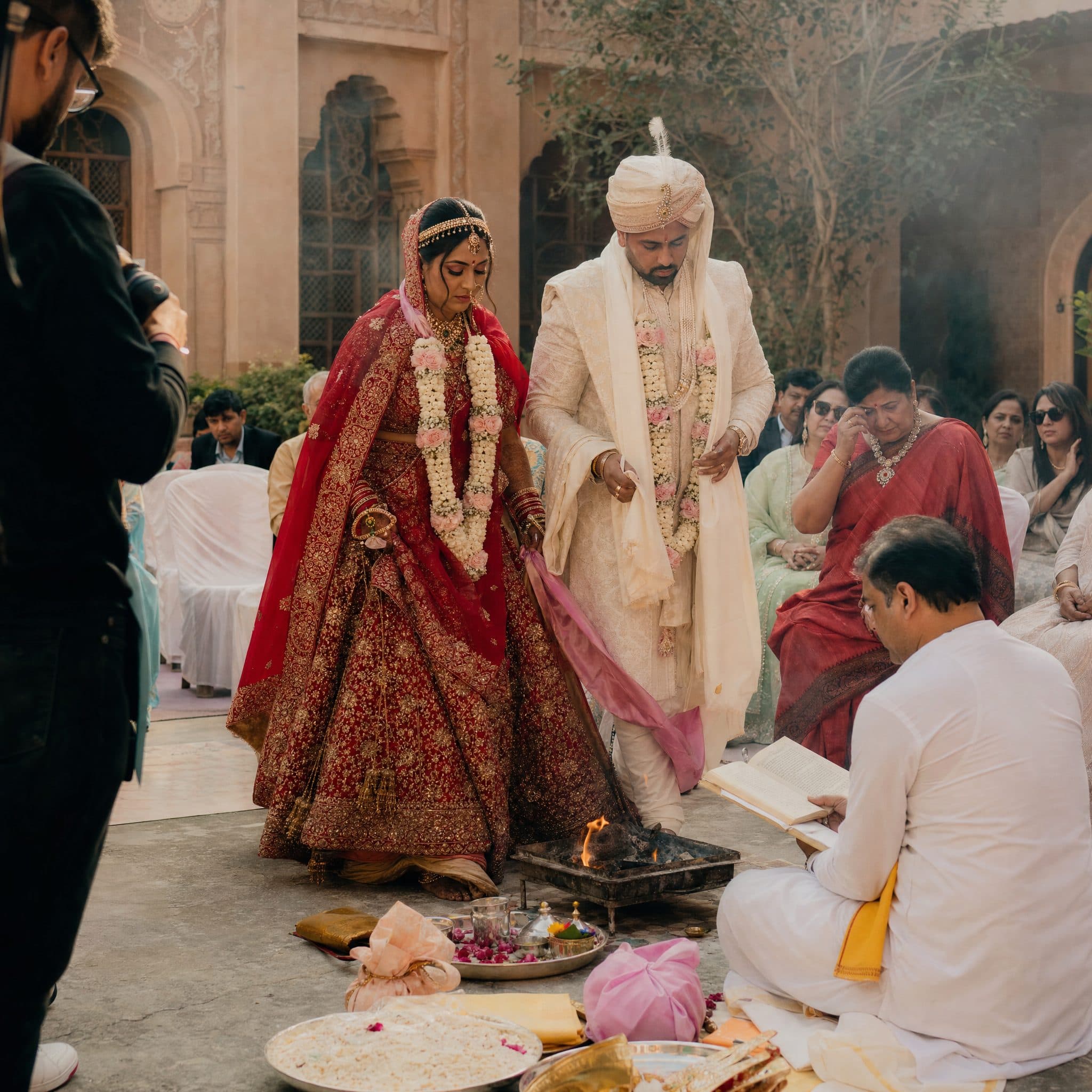
A Tamil wedding runs on a different clock from the North Indian weeks most Marrakech venues have seen. The ceremony is usually in the morning, the rites come in their own order, and the menu changes with them. Moonlight plans Indian weddings in Marrakech and nothing else, and South Indian weddings sit on our list next to Punjabi, Gujarati, Marwari, Sikh and Jain ones. Below is what a Tamil family settles with us: the muhurtham, the priest and his supplies, the garlands, the fire and the kitchen.
If you would rather talk it through with your parents on the line, book a thirty-minute introduction call. Bring rough dates and a rough guest count.
What makes a Tamil wedding different
The hour comes first. Our homepage puts it plainly: South Indian weddings are usually morning ceremonies with an entirely different sequence and menu. A Punjabi or Gujarati week builds towards a Baraat at dusk and a late reception, and the venue's staff plan their days around that.
The rites vary by community. Wikipedia's article on the Iyers, the Tamil Brahmin community, lists the main events of their wedding: Vratam (fasting), Kasi Yatra (the pilgrimage to Kasi), Oonjal (the swing), Kanyadanam, Mangalyadharanam (tying the knot) and Saptapathi, the seven steps, which it calls the final and most important stage. Nalangu, a casual and informal event, usually follows. A Chettiar, Mudaliar or Pillai family will have its own list.
Most families, whatever the community, keep the Maalai Maatral, the exchange of garlands. The Tamil Culture site describes it as the symbol of unifying two souls into one, and says the marriage is considered complete only when the bride and groom exchange their garlands. Wikipedia's entry on the garland exchange in Hindu weddings gives the plainer reading: the couple accept each other as husband and wife.
Those garlands are made in Marrakech, along with the ones for the mandap. The flower market here is daily, and our mandap and decor paper is firm on two points: order for the morning itself, never the night before, and keep the flowers cool and out of the sun until the moment. That second point is the one that most often goes wrong. A morning muhurtham helps here, because the garlands go on before the day's heat.
The first thing we ask a Tamil family for is their order of rites, written down by whoever at home knows it best. We plan the days around that list.
The muhurtham, and why it goes in the venue contract
The muhurtham is the auspicious time for the ceremony. Your family's astrologer sets it, and it is often inconvenient: it can fall at sunrise, or in a window late at night.
Inside that window sits the tying of the thali. In South India the tali is the pendant, and mangalyam or thirumangalyam is the name for the whole necklace. The groom ties it around the bride's neck in the rite called Mangalya Dharanam, and his family chooses the design according to its own custom.
Moroccan venues are used to European weddings that begin around four in the afternoon. A ceremony at seven in the morning means a mandap built overnight, staff on site before dawn and a kitchen already at work. Share the muhurtham early and we have it written into the schedule the venue signs. If it falls in the middle of the night, you pay for overnight staffing.
Settle the muhurtham before you fix the date. Many families also look at the full moon, which is the auspicious one, and a good many dates are set by it. Our full-moon dates page lists them.
The priest: we fly him in, you choose him
Arranging the pandit is part of what we do; our homepage lists it next to the overnight mandap and the fire permission. Families bring their own priest, because there is no local substitute in Morocco. So the question on our pandit, granthi and music paper, "Do you fly a pandit to a destination wedding?", has the answer "Almost always, yes." You tell us who he is, and we book his flight once the date is set.
The rule behind it covers the whole ceremony: anyone whose job is the ceremony travels with the family, and anyone whose job is sound, light and power is found here. We agree that list in month three, because lines that move after month six cost money.
What the priest uses is a second list, and the family agrees it with him about eight weeks out. He knows his rites; we know the Marrakech market. Our page on the puja that starts the week splits it like this:
- Flowers, fruit, coconut, rice and ghee are bought in Marrakech. Ask for the coconut in advance.
- Betel leaf and supari come from India, because they are not reliably found here.
- The idol, the kalash and family items travel in hand luggage, never in the hold.
- Havan samagri and specific woods are fine to fly, but check with the airline first, because they look odd in a scanner.
- Turmeric, kumkum and the sacred thread come as they are. They are tiny and never worth substituting.
If a puja opens the week on the first morning, the immediate family lands the day before everyone else. That adds two hotel nights for twenty or thirty people, so tell the family the puja date at the same time as the wedding date.
The nadaswaram and the thavil
The nadaswaram is a double reed wind instrument from Tamil Nadu. It is played at almost all Hindu weddings and temples of the South Indian tradition, usually in pairs, with a pair of drums called the thavil.
If your family wants them at the ceremony, put the players on the list of people who travel, the same month-three list as the priest. Moroccan percussion is excellent, and it is a different tradition. The sound rig, staging and power are hired locally. The reception DJ can be flown in or local: a travelling DJ knows the family's music, a local one knows the rig and the curfew, and many weddings use both.
The fire and the mandap
The Saptapadi, the seven steps, is taken around the sacred fire. That fire is lit outdoors, on a protected base, with the venue's written permission and an extinguisher nearby. Most venues refuse an indoor havan, so the mandap usually goes up in a courtyard or a garden.
We have worked in Marrakech for ten years and know which venues permit a fire and which quietly say no. The permission belongs in the contract: some venues agree to a fire in conversation and change their minds later.
The mandap goes up overnight, almost always, and the full night crew has to be in the venue contract. It can be built here or shipped flat-packed from India. Shipping takes six to eight weeks including customs and costs more.
For a morning muhurtham, plan the shade with the mandap. The ceremony is the longest sitting of the week, with immediate family on the floor around the mandap, so the shade has to reach every seated guest. Low chairs and benches go behind the floor seating, with proper chairs at the back, and nobody sits apart from their family.
The food: from the virundhu to a Moroccan kitchen
A Tamil wedding meal has a name. Wikipedia's article on Tamil cuisine calls the virundhu the food offered to guests on special occasions such as festivals and marriage ceremonies. On those days the dishes are served on banana leaves in place of plates: rice with sambar, kuzhambu, rasam, poriyal and curd, appalam on the side. Payasam comes at the end of the meal, and after it a banana and a betel leaf with areca nut, to help digestion.
That list is where the brief for your chef starts. Indian chefs and catering teams fly into Marrakech for the week, and a South Indian menu is written with the chef you bring. Produce, dairy, rice and most fresh ingredients are bought in Marrakech, and the market is good. What travels is what the chef will not compromise on: certain spice blends, specific flours and lentils. Betel leaf is on that list too, since it is not reliably found here. The split between local and imported is agreed with the chef in writing before anything is booked, because it decides the freight, the customs paperwork and the day the team arrives.
The morning muhurtham changes the kitchen's day as well. Around the ceremony we plan tea and light food, at whatever hour it falls, so a seven o'clock start means a kitchen working before dawn.
Where a family requires it, pure vegetarian food is cooked in a separate kitchen, with its own pans, boards and oil. In Morocco that separation matters, because a Moroccan kitchen is meat heavy by default.
Kitchen size is the usual limit. A palace courtyard that seats eight hundred may have a kitchen built to serve two hundred. Above roughly four hundred covers, temporary kitchen units and extra power come in.
Give your counts per event, and early. Pure vegetarian means no meat, fish or egg. Some guests may need a Swaminarayan menu, which also leaves out onion and garlic, or a Jain one, which leaves out root vegetables as well, potato, carrot and ginger included. Those are three separate briefs, and around fifteen percent of a confirmed guest list moves in the final fortnight. More in feeding four hundred.
Which months suit a morning wedding
Pick the month with the heat in mind. Our when to marry page recommends two windows, March to May and September to November, and calls October close to perfect. July and August regularly pass 40°C, and no misting fan fixes that for older guests sitting on the floor through the ceremony.
Venues for April, May and October dates are often booked about eighteen months ahead. Late March, early June and late November are easier to book.
Before you sign a venue
We visit with your programme in hand. For a Tamil wedding, that programme gets four answers in writing:
- Will the venue sign a schedule with a sunrise or early morning muhurtham, including overnight access for the mandap crew?
- Where can the fire be lit, and is that permission in the contract?
- Can the kitchen be split so pure vegetarian food is cooked apart, and where do the temporary units and the generator go?
- What time does the music stop, and is that a house rule or a municipal one?
The venues paper covers the palaces and estates around Marrakech, which commonly hold 150 to 800 guests.
As far as your family is concerned, the ceremony in Marrakech is the wedding. The legal registration almost always happens at home, in the country you live in. We tell you this early, in month one, and the details are in the legal bit. We plan weddings and do not give legal advice.
Questions
Can a Tamil Hindu wedding be held in Morocco?
Yes. Hindu rites take place at private venues, and a sacred fire can be lit in an outdoor mandap with the venue's agreement, which we get in writing.
Can we bring our own priest to Marrakech?
Yes, and almost every family does, because there is no local substitute in Morocco. You choose him, we arrange him and book his flight once the date is set, and you agree his supplies with him about eight weeks out.
What is served at a Tamil wedding meal?
The virundhu: rice, sambar, kuzhambu, rasam, poriyal and curd with appalam, traditionally on a banana leaf, then payasam, and a banana with betel leaf after the meal. In Marrakech it becomes the brief for the Indian chef who flies in for the week.
What time is a Tamil wedding ceremony?
At the muhurtham your family's astrologer sets, which is often in the morning. We have it written into the venue's signed schedule early.
What is the Maalai Maatral?
The exchange of garlands between bride and groom. In Marrakech the garlands are made locally, ordered for that morning and kept cool until the moment.
Tell us your dates
Send us rough dates, a guest count and the cities everyone is flying from. If you have a written order of rites, send that too, with your priest's name. Book a thirty-minute introduction call, with your parents on the line if they want to be.
Planners with a Tamil family on their books can read working with a Marrakech ground team: you keep the client, the design and the relationship, and we hold the venue, the permits, the suppliers and the crew. For a North Indian week to compare with, read a Punjabi wedding in Marrakech.