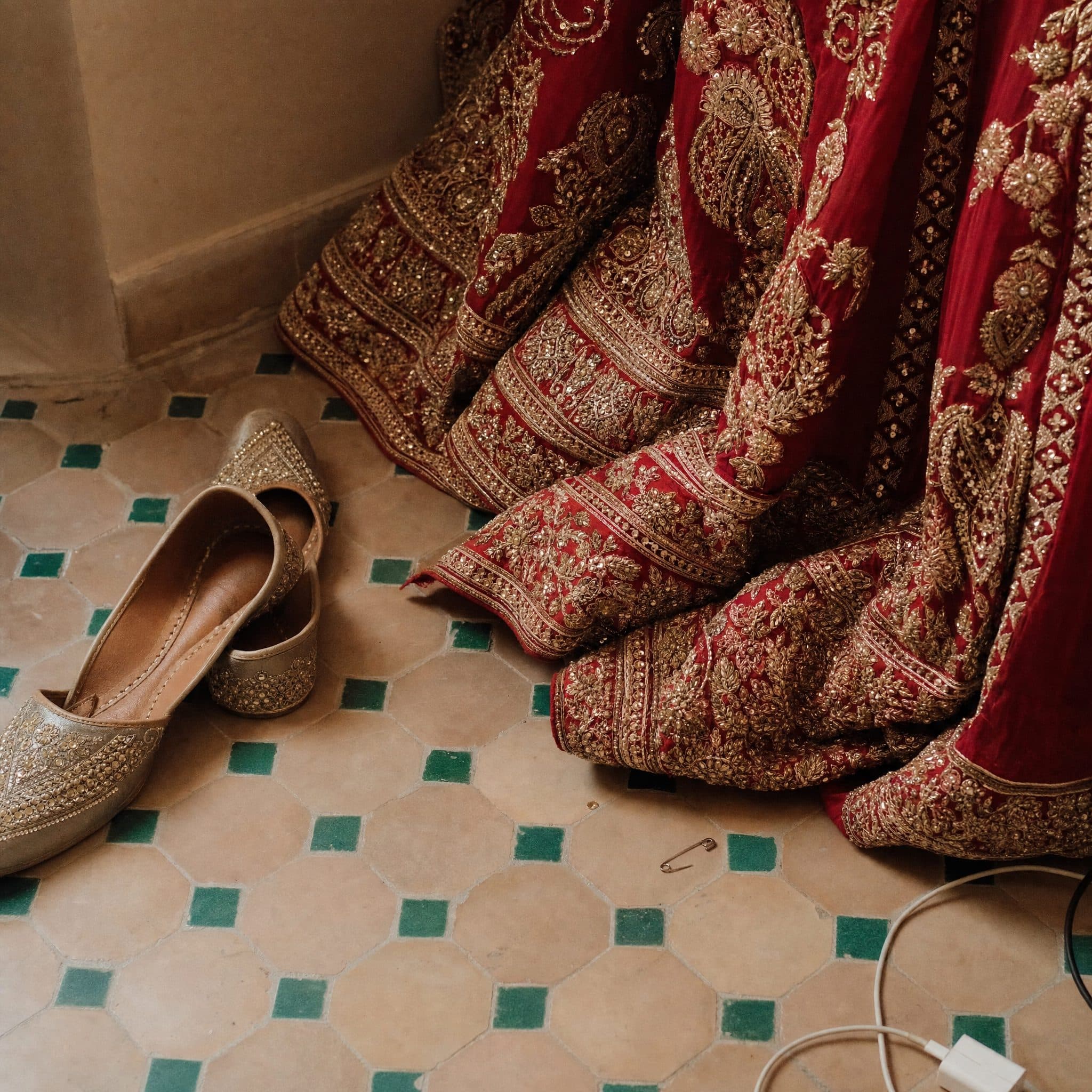
An Indian wedding in Marrakech is several days of events in a palace or a private estate, and each one asks something different of your clothes. The Haldi stains. The Mehndi puts you on low seating for an hour with your hands out. At the Baraat you dance backwards up a drive. The reception runs past midnight, and in December the air after dark drops to single figures.
This guide covers what guests wear, the colours to leave alone, what each event asks of your outfit, and what to pack for the month you are flying.
Start with the guest pack
A good guest pack comes in two parts. The save-the-date goes out months ahead, with the essentials. The full pack goes with the formal invitation and carries the schedule, a dress note for each event, travel, rooms, transfers and one named contact: a person, an email and a WhatsApp number, printed on the pack.
Read the dress notes twice. A well-written pack gives the colour for the Haldi, says the Sangeet is formal, and warns that the evenings are cold in November. If yours is vague, message the named contact and ask. One question before you fly saves you a cold night in a silk kurta at the reception.
Planning a wedding and writing that pack yourself? Our paper on what to put in the guest pack covers it section by section. If you want to talk it through with us, book a thirty-minute introduction call.
What guests wear: saree, lehenga, kurta or a suit
Most guests at an Indian wedding wear Indian clothes, and a few garment names cover nearly everything you will see.
For women, the usual choices are a saree, a lehenga (a cropped blouse with a full skirt) and a sharara (wide trousers with a matching tunic), as WeddingWire lists them. A salwar kameez or an anarkali suit is the easier option for daytime events: no draping, no pinning. A dupatta, the long scarf worn with most of these, also covers your head when a ceremony asks for it.
For men, a kurta pyjama is a long collarless tunic over loose trousers. A sherwani is a knee-length embroidered coat over fitted trousers or churidars. A bandhgala, also called a Jodhpuri suit, is a formal jacket with a closed Nehru collar. A well-cut Western suit is fine at any of the formal events.
Here is what that usually means for each event. Your pack overrides all of it.
| Event | Women usually wear | Men usually wear |
|---|---|---|
| Haldi | An old kurta or salwar kameez in the colour the pack gives | An old kurta in the colour the pack gives |
| Mehndi | A light salwar kameez, anarkali or kurti, with sleeves that push up | A cotton kurta pyjama |
| Sangeet | A lehenga, sharara or saree you can dance in | A dressier kurta pyjama or a bandhgala |
| Baraat | Your ceremony outfit, since it comes straight before | Your ceremony outfit, since it comes straight before |
| Pheras | A saree, lehenga or salwar kameez | A kurta pyjama, sherwani or suit |
| Anand Karaj | A salwar kameez or saree, with a dupatta to cover your head | A kurta pyjama or suit, with a rumal or scarf for your head |
| Reception | Your most formal saree or lehenga, or a long gown | A sherwani, bandhgala or suit |
Colours: what to leave to the bride
Red is the traditional colour of the Hindu bride, so guests leave it to her. That includes deep bridal reds and anything that reads as a bridal outfit from across a courtyard.
Many families also avoid all-white and all-black. In India and South Asia white is associated with funerals, and black is seen as an unlucky colour for Hindu ceremonies. Bright colours are the safe default for everything else.
Treat that as a general rule and check the pack. Our Haldi paper gives families one line of advice: bring more white clothes than you think. If the pack asks for white at the Haldi, wear white. Sikh, Jain and regional customs differ too, so when the colour is unclear, ask the named contact.
What to wear, event by event
The week usually runs in this order: Haldi in the morning, Mehndi in the afternoon, the Sangeet at night, then the wedding day with the Baraat, the ceremony and the reception. The four days paper walks through the full week. Here is what each part means for your wardrobe.
| Event | When it usually runs | Setting | What your outfit has to handle |
|---|---|---|---|
| Haldi | Morning, usually 9 to 11 | Garden or shaded courtyard, never indoors | Turmeric. Expect stains |
| Mehndi | Guest stations from noon, closes around 17:00 | Shaded courtyard, low seating | An hour seated with your hands out, flat shoes |
| Sangeet | Night, outdoor sound until midnight | Outdoor stage, last hour often moved indoors | Formal, and built for dancing |
| Baraat | Late afternoon into dusk, about half an hour | Down the estate drive or through the palace gate | Dancing on uneven ground |
| Pheras or Anand Karaj | At the muhurat (Pheras); usually morning (Anand Karaj) | Mandap, or a room set as the Darbar Sahib | Sitting on the ground. Head covering for the Anand Karaj |
| Reception | Drinks from 19:00, close around 01:00 or the curfew | Palace courtyard, candlelit | Your most formal outfit, plus a layer in winter |
Haldi: wear what you can lose
The Haldi is the smallest event of the week, often kept to family. It happens outside, in a garden or a shaded courtyard, usually between nine and eleven in the morning before the heat builds.
Turmeric stains, and it stains permanently. It does not come out in the wash. If the pack gives a colour, find something in that colour you will not miss.
Guests usually sit on the ground for the Haldi. If getting down or up is hard for you, there should be low chairs and benches at the edge of the same space, so nobody has to ask.
Mehndi: flat shoes and sleeves that push up
At the Mehndi, the bride has her henna first thing in the morning and guest stations open around noon. A guest design takes five to ten minutes. After that, the henna needs two to three hours before it can be scraped, and the colour deepens the longer it stays on.
You will sit for about an hour with your hands out, so wear sleeves that push well clear of your wrists. Expect finger food too, since nobody with wet henna can hold cutlery.
Leave the heels in your room. A Mehndi with floor seating in a courtyard is not a stiletto event. More on how the afternoon is set up in Mehndi at guest volume.
Sangeet: formal, and built for dancing
The Sangeet is the loudest night of the week, held before the ceremony. Families perform on a built stage, and the evening ends with everyone on the floor.
Dress formally, in something you can move in. Outdoor amplified sound in Marrakech is generally allowed until midnight, and many families move the last hour indoors to keep going, so plan for a late night. Some private estates allow music until one or two in the morning. Our Sangeet paper explains the curfew.
Baraat: shoes for dancing on a drive
The Baraat is the groom's procession, with dhol players and his side dancing him in. On private grounds it comes down the estate drive or through the palace gate, late afternoon into dusk, so nobody dances in direct overhead sun. A good one lasts about half an hour, with a couple of hundred people dancing backwards in heavy clothes.
Choose shoes you can dance in on uneven ground, and a hem that will not catch. If you are handed a safa, give it back to the family afterwards. The sehra, kalgi and safa often go missing because they are always handed to whoever is nearest. The Baraat paper covers the horse, the dhol and the route.
Pheras and Anand Karaj: clothes you can sit in
A Hindu ceremony, the Pheras, runs ninety minutes to two hours. Its time is the muhurat, set by the family's astrologer, which can fall at sunrise or late at night. The immediate family sits on the floor around the mandap, with low chairs and benches behind for anyone who wants them.
A Sikh ceremony, the Anand Karaj, is usually in the morning and takes an hour or more, with kirtan before it. Everybody sits on the ground facing the Guru Granth Sahib. Heads are covered and shoes removed in that room, and there is no alcohol or meat in that space. Pack a scarf, a dupatta or a rumal so you are not hunting for one at the door, and wear something that lets you sit on the floor for an hour. See the Pheras and the Anand Karaj, and our guide to a Punjabi wedding in Marrakech.
Reception: your most formal outfit
The reception is the only formal meal of the week. Guests arrive at seven, dinner is served at half past eight, and the evening closes at one in the morning or whenever the venue's music curfew falls. That is around six hours.
While the ceremony space is turned into the reception, guests go back to their rooms to change. By then the wedding day may already have meant six hours of sitting, standing, processing and eating in heavy clothes, so a fresh outfit helps. This is also the evening where a gown, a suit or a fusion outfit sits most easily next to sarees and sherwanis. Read Seating eight hundred for how the evening runs.
What to wear in Marrakech, month by month
Marrakech has bright days and cold nights for a good part of the year. For your suitcase, the gap between the afternoon Mehndi and the end of the reception matters more than the daytime high. These figures come from our paper on when to marry in Marrakech.
| Month | Daytime | After dark | What to pack |
|---|---|---|---|
| January | High teens | Single figures | A warm wrap or coat for every evening. Evening events need heating |
| February | High teens to twenty | Single figures | As January. Evenings stay cold |
| March | Low twenties | Around ten | Light layers. It can still rain |
| April | Mid twenties | Low teens | Close to ideal. A shawl or jacket for late nights |
| May | Around thirty | Mid teens | Light fabrics for the day. Afternoons already need shade |
| June | Mid thirties | High teens | Breathable fabrics and sun protection for daytime events |
| July | Regularly past 40°C | Low twenties | The lightest fabrics you own. The hardest month for a wedding |
| August | Regularly past 40°C | Low twenties | As July |
| September | Mid thirties, falling | High teens | Hot in the first half, very good in the second |
| October | Around thirty | Mid teens | The best month of the year here. Light layers |
| November | Low twenties | Low teens | Mild days. A layer for the evenings, and a rising chance of rain |
| December | High teens | Single figures | A real coat or a heavy shawl after dark |
Desert and foothill weddings
Agafay is a stone desert with no shade at all, and the wind gets up in the late afternoon most days. The temperature swings after dark. The Atlas foothills are several degrees cooler than the city, and in March and April there is still snow up there. Bring a warmer layer than the city table suggests. Our paper on the desert and the foothills explains how these sites differ from the city.
Older guests
An afternoon above thirty-five degrees makes an unshaded courtyard unusable by one o'clock, and older guests rarely complain. Gravel is impassable with a stick, and some estates have three hundred metres of uneven ground between the car and the seat. Steady, flat shoes matter more than any outfit. More in Children, and the grandparents.
Getting an outfit, and travelling with it
If you do not own Indian clothes, buy them before you fly. WeddingWire suggests an Indian, Pakistani or Nepalese clothes shop near home. Try everything on at home, with the shoes you will wear.
Indian wedding clothes are heavy, embroidered and hard to replace at short notice. A few habits worth copying:
- Carry the outfit that matters most in your hand luggage. Our rule for the bride's lehenga is that it flies in hand luggage or it does not fly. A lost bag cannot be put right in Marrakech two days before the ceremony, and your reception outfit deserves the same care.
- Hang everything the day you arrive. Steam the embroidered pieces and keep them somewhere dark and dry.
- Ask about a tailor. One can be arranged locally at short notice and is worth having on standby for the whole week, for repairs and last fittings. Your named contact will know.
- Pack one outfit per event, plus old clothes for the Haldi morning.
Flying in from Mumbai, Delhi, Dubai or London? Our flights paper and guest logistics cover the journey. Indian passport holders should read Morocco visas for Indian passport holders and confirm the current rules with the official authorities before booking.
Questions guests ask
Where do I find the dress code for each event?
In the full guest pack, which goes out with the formal invitation. It should give a dress note per event and one named contact for questions.
Can I wear Western clothes?
Yes, if they are modest. A modest dress, a classic suit, or a long-sleeved shirt with trousers is fine. Leave out cleavage, mini dresses and anything clingy or revealing. Fusion outfits are common at the reception. Indian dress is welcome on non-Indian guests too, and WeddingWire calls it one of the best routes when you are unsure. If you want to check a specific outfit, ask the named contact in your pack.
Can I wear red, white or black?
Leave red to the bride. Many families avoid all-white and all-black at Hindu ceremonies, but if your pack names a colour, that colour wins.
Will turmeric wash out after the Haldi?
No. Turmeric stains permanently. Wear something you are happy to lose.
Can I wear heels?
Save them for the reception, and check the ground first. The Mehndi uses low seating in a courtyard, the Baraat comes down a drive, and gravel and uneven ground are common on estates.
Do I need to cover my head?
At an Anand Karaj, yes: heads are covered and shoes removed in the room set as the Darbar Sahib. Bring your own scarf, dupatta or rumal.
How cold does it get at night?
From December to February, Marrakech drops to single figures after dark. November nights are in the low teens, and in July and August they stay in the low twenties.
Planning the wedding, or the guest pack?
If you are the couple, a parent or the planner, the dress notes are one page of the guest pack, and the guest pack is one part of the week we plan with families in Marrakech. Send us rough dates, a guest count and the cities your family flies from, and we will talk you through it: book a thirty-minute introduction call, or write to hello@moonlight.wedding.
Guests can forward this page to anyone in their party who is still packing.